Clinical Dermatology Books Recommended by Doctors: Best Textbooks for Medical Students and Practitioners
Dermatology is a highly visual and clinically oriented specialty. Recognizing a skin lesion is only the beginning; medical students and doctors must also understand morphology, distribution, differential diagnosis, investigations, and treatment principles.
This makes choosing the right clinical dermatology book particularly important.
So, which clinical dermatology books are commonly recommended for medical students and doctors?
Quick answer: Widely recognized dermatology resources include Clinical Dermatology by Thomas P. Habif, Rook’s Textbook of Dermatology, Fitzpatrick’s Dermatology, IADVL Textbook of Dermatology, and concise undergraduate-oriented dermatology textbooks used in Indian medical education. The best choice depends on whether you are an MBBS student, postgraduate trainee, dermatologist, or general practitioner.
A practical rule is simple:
MBBS students need clarity and clinical orientation. Postgraduates need depth. Practitioners need reliable diagnostic and management references.
Best Clinical Dermatology Books at a Glance
| Book | Best Suited For | Major Strength |
|---|---|---|
| Clinical Dermatology by Habif | Students and clinicians | Clinical and visual approach |
| Rook’s Textbook of Dermatology | Postgraduates and specialists | Comprehensive reference |
| Fitzpatrick’s Dermatology | Advanced learners and dermatologists | Scientific and clinical depth |
| IADVL Textbook of Dermatology | Indian postgraduate learners | India-relevant dermatology coverage |
| Concise Undergraduate Dermatology Textbooks | MBBS students | Exam-oriented learning and revision |
No single textbook is ideal for every learner. A book should match your current academic and clinical requirements.
1. Clinical Dermatology by Thomas P. Habif
Clinical Dermatology by Thomas P. Habif is a widely recognized clinical resource that emphasizes the diagnosis and management of common skin diseases.
It is particularly useful for learners who want to connect:
Appearance of lesion → Clinical pattern → Differential diagnosis → Management
Why Is It Useful?
Its clinical orientation can help readers understand:
- Common dermatological disorders
- Morphology of skin lesions
- Differential diagnosis
- Clinical patterns
- Treatment principles
Because dermatology depends heavily on pattern recognition, a clinically organized resource can be valuable for students and practitioners.
Best for: Medical students, residents, and clinicians seeking a practical dermatology reference.
2. Rook’s Textbook of Dermatology
Rook’s Textbook of Dermatology is a major comprehensive reference in the specialty.
It covers dermatology at a depth more appropriate for:
- Postgraduate trainees
- Dermatology residents
- Specialists
- Academic departments
- Clinicians requiring detailed reference material
Key Strength
Rook’s is not usually the first book an MBBS student needs to read from beginning to end. Its strength lies in detailed reference-level coverage.
It can be particularly valuable when a learner needs to explore a disease beyond the level provided by an undergraduate textbook.
Best for: Advanced dermatology study and specialist reference.
3. Fitzpatrick’s Dermatology
Fitzpatrick’s Dermatology is another internationally recognized dermatology reference known for combining scientific foundations with detailed clinical information.
It is particularly relevant for readers interested in:
- Disease mechanisms
- Advanced diagnosis
- Dermatological science
- Complex disorders
- Evidence-based clinical understanding
For an undergraduate student, the level of detail may be greater than necessary for routine university preparation.
However, for postgraduate trainees and specialists, it can serve as an important reference.
Best for: Advanced learners, dermatology residents, researchers, and specialists.
4. IADVL Textbook of Dermatology
The IADVL Textbook of Dermatology is particularly relevant in the Indian medical education and clinical context.
A locally relevant dermatology reference can be valuable because disease patterns, epidemiology, clinical exposure, and practice settings may differ across regions.
It is generally more suitable for learners who require substantial subject depth, including:
- Dermatology postgraduates
- Residents
- Practising dermatologists
- Advanced medical learners
Best for: Detailed dermatology learning with relevance to Indian clinical practice.
5. Concise Dermatology Textbooks for MBBS Students
Most MBBS students do not need to begin with a multi-volume specialist reference.
For undergraduate learning, the ideal dermatology textbook should provide:
- Clear definitions
- Basic lesion morphology
- Common diseases
- Clinical photographs
- Differential diagnosis
- Essential investigations
- Basic treatment principles
- University-oriented coverage
Common undergraduate resources may include concise dermatology textbooks by established authors used in Indian medical colleges.
The exact choice should be guided by:
- University syllabus
- Faculty recommendations
- Clinical posting requirements
- Personal learning style
Best for: MBBS university preparation and introductory clinical dermatology.
Which Dermatology Book Is Best for MBBS Students?
For most MBBS students, the best dermatology book is a concise undergraduate textbook with clear clinical photographs and structured explanations.
An MBBS student should first master:
- Primary and secondary skin lesions
- Approach to a dermatology patient
- Common bacterial skin infections
- Fungal infections
- Viral skin diseases
- Parasitic infestations
- Eczema and dermatitis
- Psoriasis
- Acne
- Drug reactions
- Pigmentary disorders
- Leprosy
- Sexually transmitted infections, where included in the curriculum
A specialist reference can then be used selectively for difficult topics.
Which Dermatology Book Is Best for Postgraduate Students?
Postgraduate trainees generally need greater depth.
A practical resource strategy may include:
One comprehensive textbook + one clinical/visual reference + current guidelines and literature
For example, a postgraduate learner may use:
- Rook’s for comprehensive reference
- Fitzpatrick’s for advanced scientific and clinical depth
- IADVL resources for Indian context
- Habif for practical clinical correlation
The goal is not to read every textbook simultaneously. Each resource should have a defined purpose.
Which Dermatology Book Is Best for General Practitioners?
General practitioners frequently encounter conditions such as:
- Acne
- Eczema
- Fungal infections
- Bacterial infections
- Urticaria
- Psoriasis
- Drug eruptions
- Pigmentary disorders
A clinically focused dermatology book with strong visual content may be more useful than an extremely detailed specialist reference.
The resource should help answer:
- What does the lesion look like?
- What are the likely differential diagnoses?
- What initial investigations may be appropriate?
- What are the general management principles?
- When is specialist referral required?
A book such as Clinical Dermatology by Habif can support this practical learning approach.
How to Choose the Right Clinical Dermatology Book
Before buying a dermatology textbook, consider these factors:
1. Your Academic Level
An MBBS student, dermatology resident, and practising specialist require different levels of detail.
2. Quality of Clinical Images
Dermatology is visual. High-quality clinical photographs and illustrations can significantly improve pattern recognition.
3. Organization
Look for a book that makes it easy to connect morphology, diagnosis, differential diagnosis, and management.
4. Edition
Medical knowledge evolves. Check the latest available edition and whether your institution recommends a specific version.
5. Purpose
Ask whether you need the book for:
- University exams
- Clinical postings
- Postgraduate training
- Daily clinical reference
- Research
Your purpose should determine your purchase.
How to Study Clinical Dermatology Effectively
Use a fixed clinical framework for every condition:
Definition → Etiology → Morphology → Distribution → Clinical Features → Differential Diagnosis → Investigations → Management
For example, when studying a rash, do not memorize only the disease name.
Ask:
- What is the primary lesion?
- Where is it distributed?
- Is it symmetrical?
- Is it itchy or painful?
- Are mucous membranes involved?
- Are there systemic symptoms?
This transforms textbook reading into clinical reasoning.
Clinical photographs should also be studied actively. Describe the lesion before reading the diagnosis.
Where to Buy Clinical Dermatology Books Online
When purchasing medical textbooks online, verify:
- Correct title and author
- Latest available edition
- Publisher
- Book format
- Seller reliability
- Suitability for your academic level
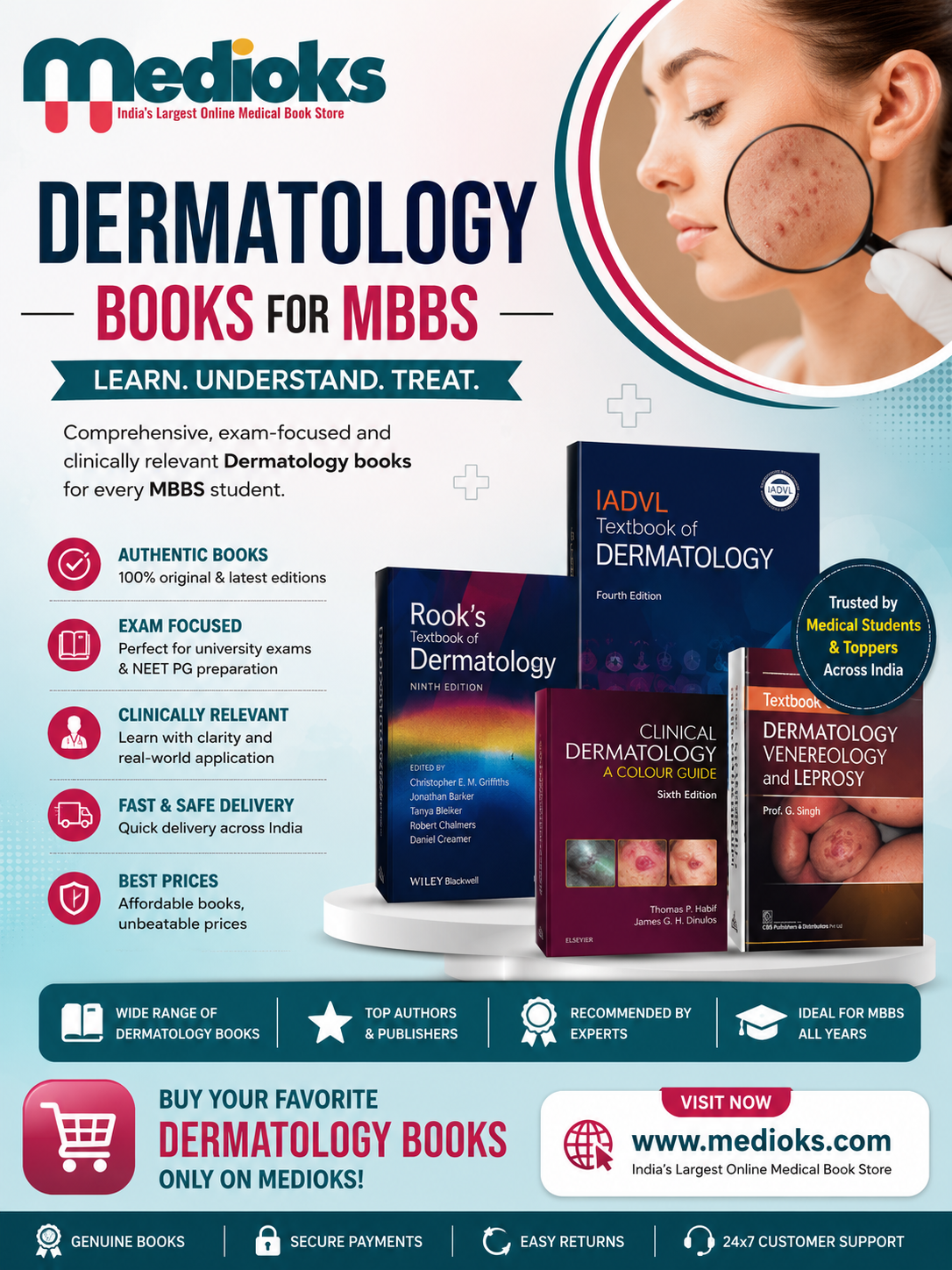
Students and medical professionals searching for clinical dermatology books, dermatology textbooks for MBBS, and other medical resources can explore relevant titles through Medioks.
Always confirm the edition and academic requirements before purchasing.
Frequently Asked Questions
Which is the best clinical dermatology book?
The best choice depends on the reader. Habif is useful for practical clinical learning, while Rook’s and Fitzpatrick’s are comprehensive advanced references. Indian postgraduate learners may also consider IADVL resources.
Which dermatology book is best for MBBS students?
A concise undergraduate textbook with clear clinical images and syllabus-oriented coverage is usually the most practical choice.
Is Rook’s Dermatology suitable for MBBS?
It can be used as a reference, but its depth may exceed routine undergraduate requirements.
Is Habif good for clinical dermatology?
Yes. It is widely valued for its practical and clinically oriented presentation.
Do doctors need the latest edition of a dermatology book?
A recent edition is preferable because diagnostic approaches, classifications, and treatment information can evolve. For clinical decisions, textbooks should also be supplemented with current professional guidance.
Final Thoughts
The best clinical dermatology books recommended by doctors vary according to the reader’s level and purpose.
For practical clinical learning, Clinical Dermatology by Habif is a strong option. For advanced and comprehensive study, Rook’s Textbook of Dermatology and Fitzpatrick’s Dermatology are major references. The IADVL Textbook of Dermatology offers particular relevance for advanced learners in the Indian context, while MBBS students may benefit most from a concise undergraduate textbook.
The smartest approach is not to collect every famous dermatology book.
Choose one primary book that matches your level, use a comprehensive reference selectively, and connect every disease with real clinical morphology.
In dermatology, successful learning depends on developing the ability to observe accurately, describe systematically, and reason clinically.