Which Medical Book Combination Is Best for University Exams? A Complete Guide for MBBS Students
Introduction
One of the biggest challenges faced by MBBS students is selecting the right combination of textbooks for university examinations. With countless options available, students often struggle to decide whether they should focus on standard reference books, exam-oriented guides, or a combination of both.
The truth is that no single textbook can meet every academic need. The most successful medical students usually rely on a carefully selected combination of conceptual textbooks, practical manuals, and revision resources that align with the university curriculum.
Whether you are searching for MBBS first year books, microbiology books for MBBS, medicine textbook MBBS, or final year MBBS books, choosing the right resources can significantly improve conceptual understanding, answer-writing skills, and examination performance.
This comprehensive guide explains the ideal medical book combinations for every phase of MBBS while following the latest competency-based medical education (CBME) approach recommended by the National Medical Commission (NMC).
Why Choosing the Right Medical Book Combination Matters
Medical education is vast and requires a balance between theory, practical knowledge, and clinical application.
The right book combination helps students:
- Understand concepts effectively
- Prepare for university examinations
- Improve practical performance
- Build clinical reasoning skills
- Reduce study overload
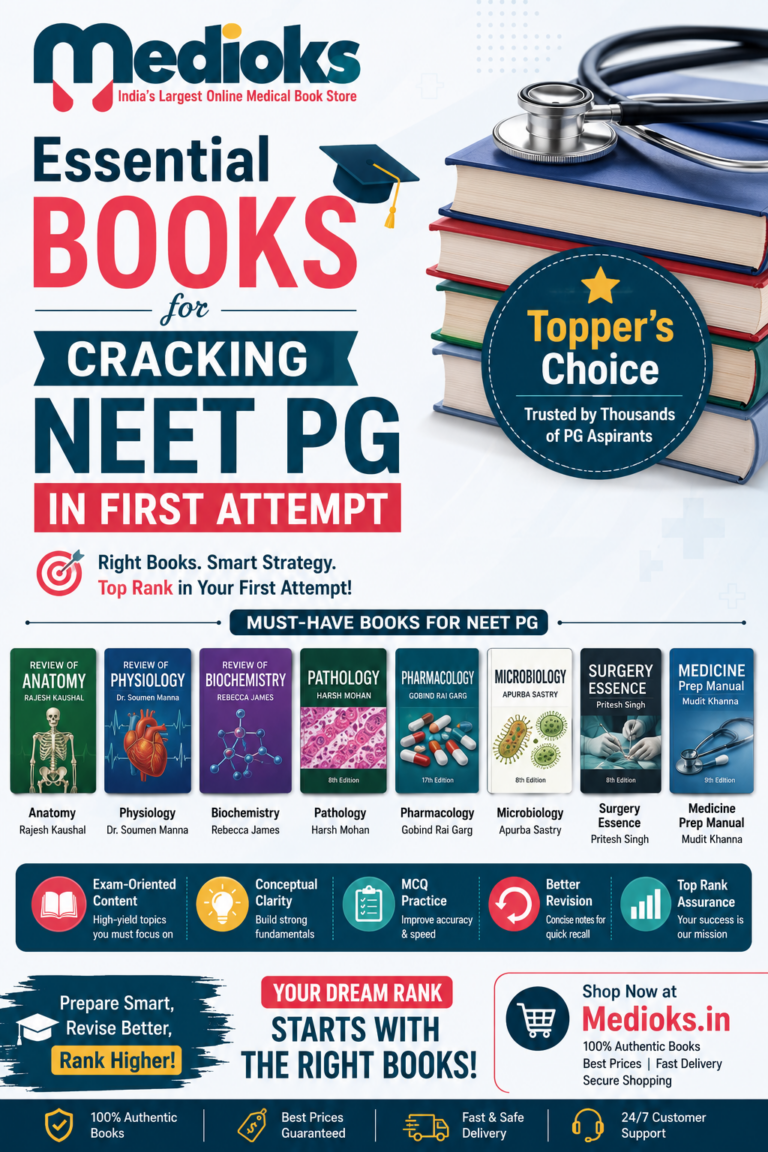
- Prepare for future exams like NEET PG and NEXT
Instead of reading multiple books for a single subject, students should focus on mastering a few trusted resources.
What Makes an Ideal MBBS Book Combination?
An effective study combination usually consists of:
Primary Textbook
Provides conceptual understanding and detailed explanations.
Examination-Oriented Resource
Helps with answer writing and university preparation.
Practical Manual
Supports laboratory and clinical learning.
MCQ or Revision Resource
Useful for self-assessment and long-term retention.
This approach ensures balanced preparation without overwhelming the student.
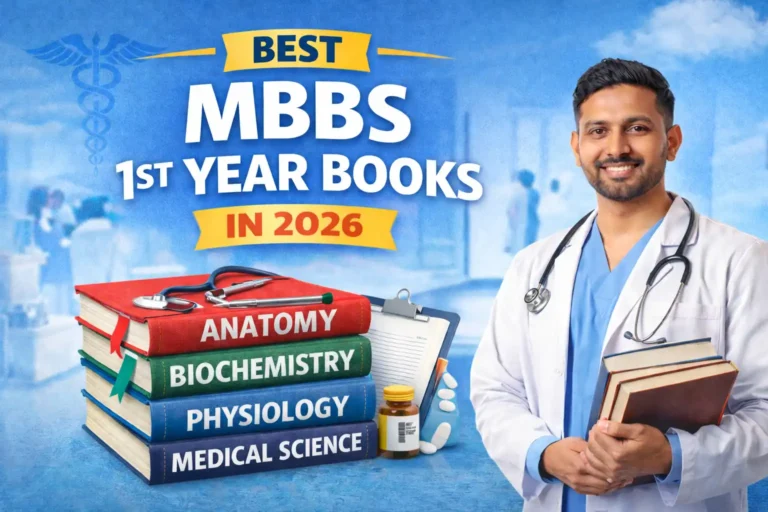
Best MBBS First Year Books Combination
The first year builds the foundation of medical sciences.
Anatomy
Recommended Combination
Primary Book
- B.D. Chaurasia Human Anatomy
Reference Book
- Gray’s Anatomy for Students
This combination provides both exam-oriented learning and conceptual depth.
Students frequently consider B.D. Chaurasia one of the most useful resources when searching for an anatomy book for MBBS 1st year.
Physiology
Recommended Combination
Primary Book
- G.K. Pal Physiology
Reference Book
- Guyton and Hall Physiology
This pairing offers excellent conceptual understanding and university exam preparation.
Biochemistry
Recommended Combination
Primary Book
- Satyanarayana Biochemistry
Reference Book
- Harper’s Illustrated Biochemistry
Students looking for reliable biochemistry books MBBS often find this combination highly effective.
Best MBBS Books for 2nd Year
The second year introduces subjects that form the basis of clinical medicine.
Many students actively search for MBBS books for 2nd year because these subjects are crucial for future entrance examinations.
Pathology
Recommended Combination
Primary Book
- Harsh Mohan Pathology
Reference Book
- Robbins Basic Pathology
Benefits include:
- Strong conceptual understanding
- Excellent illustrations
- Clinical integration
Pharmacology
Recommended Combination
Primary Book
- K.D. Tripathi Medical Pharmacology
Revision Resource
- Pharmacology review notes
When students search for medical pharmacology, K.D. Tripathi remains one of the most recommended textbooks in India.
Microbiology
Microbiology is one of the highest-yield subjects in university examinations and postgraduate entrance tests.
Recommended Combination
Primary Book
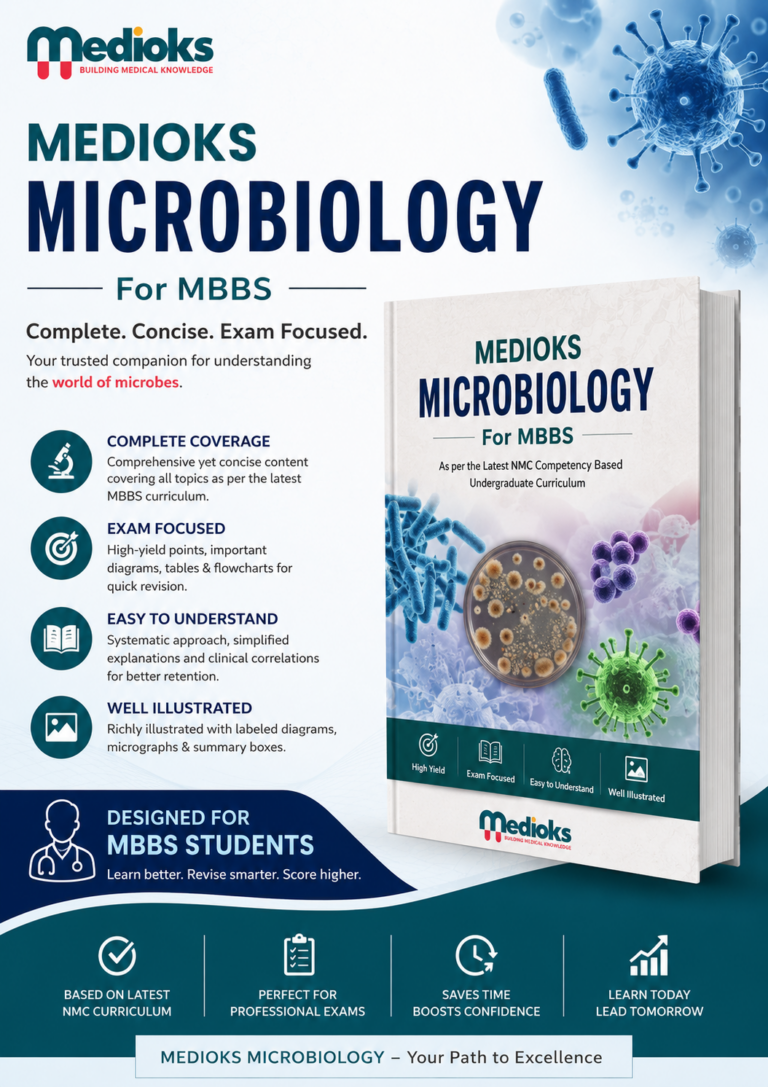
- Apurba Sastry Microbiology
Reference Book
- Ananthanarayan and Paniker’s Microbiology
This is often considered the ideal choice among microbiology books for MBBS.
Students frequently ask for the best book for microbiology MBBS, and Apurba Sastry consistently ranks among the top recommendations because of its concise presentation and exam-oriented approach.
Best Third-Year MBBS Book Combination
Third-year subjects introduce clinical relevance and community health concepts.
Community Medicine
Primary Book
- Park’s Textbook of Preventive and Social Medicine
Supplementary Resource
- Community medicine notes and question banks
Park remains the gold standard for community medicine preparation.
Best Final Year MBBS Books Combination
The final year focuses heavily on clinical application, diagnosis, and patient management.
Students often search for reliable final year MBBS books because these subjects contribute significantly to professional competency.
General Medicine
Recommended Combination
Primary Book
- Davidson’s Principles and Practice of Medicine
Reference Book
- Harrison’s Principles of Internal Medicine
For students looking for general medicine books for MBBS or a trusted medicine textbook MBBS, Davidson remains one of the most student-friendly options.
Surgery
Recommended Combination
Primary Book
- Bailey & Love’s Short Practice of Surgery
Reference Book
- SRB Surgery
This combination balances conceptual understanding and examination preparation.
Obstetrics and Gynecology
Recommended Combination
Primary Book
- D.C. Dutta’s Textbook of Obstetrics
Gynecology Resource
- Dutta Gynaecology
The combination of obstetrics and Dutta Gynaecology remains highly popular among MBBS students preparing for university examinations.
Pediatrics
Recommended Combination
Primary Book
- Ghai Essential Pediatrics
Revision Resource
- Clinical pediatrics notes
This combination provides excellent exam preparation and practical understanding.
Are GNM Books Useful for MBBS Students?
Some students compare medical textbooks with GNM books while looking for simplified explanations.
GNM books may help beginners understand basic concepts, but MBBS students should primarily rely on MBBS-specific resources because:
- The syllabus is more extensive
- Clinical depth is greater
- Examination standards differ significantly
Therefore, GNM books can be supplementary but should not replace standard MBBS textbooks.
How to Study Using These Book Combinations
Simply owning books is not enough.
Students should follow a structured strategy:
Step 1
Read concepts from the primary textbook.
Step 2
Clarify difficult topics using the reference book.
Step 3
Prepare concise notes.
Step 4
Practice university questions.
Step 5
Revise regularly.
This method improves retention and answer-writing quality.
Common Mistakes Students Make
Using Too Many Resources
Reading multiple books for the same subject often causes confusion.
Ignoring Standard Textbooks
Short notes alone cannot build strong concepts.
Studying Only Before Exams
Consistent learning produces better long-term results.
Avoiding Clinical Correlation
Understanding clinical applications improves both university and competitive exam performance.
Choosing Trustworthy Medical Books
Medical education belongs to a high-trust category where accuracy is essential.
Students should evaluate resources based on:
Experience
Recommendations from successful seniors and faculty.
Expertise
Books written by recognized medical experts.
Authoritativeness
Resources accepted by leading medical colleges.
Trustworthiness
Regularly updated and evidence-based content.
Following these principles helps students build reliable medical knowledge.
Frequently Asked Questions
Which medical book combination is best for university exams?
A combination of one primary textbook, one reference book, and revision notes is generally the most effective strategy.
Which is the best book for microbiology MBBS?
Apurba Sastry Microbiology is widely recommended because of its clarity and examination relevance.
Which medicine textbook MBBS students should use?
Davidson’s Principles and Practice of Medicine is one of the most student-friendly and widely used medicine textbooks.
Are MBBS first year books important for NEET PG?
Yes. Strong fundamentals from first-year subjects significantly improve postgraduate entrance preparation.
Conclusion
Choosing the right medical book combination is one of the most important academic decisions for MBBS students. Rather than collecting numerous resources, students should focus on a balanced combination of conceptual textbooks, exam-oriented materials, and revision tools.
From MBBS first year books like B.D. Chaurasia and G.K. Pal to advanced resources such as Apurba Sastry Microbiology, K.D. Tripathi Medical Pharmacology, Davidson’s Medicine, and Dutta Gynaecology, every book plays a unique role in building medical competence.
The most effective strategy is not studying the maximum number of books but mastering the right combination. With disciplined study habits, regular revision, and trusted resources, students can excel in university examinations while building a strong foundation for future clinical practice and competitive exams.