Expert Guide to Choosing MBBS Books in India: A Complete Roadmap for Medical Students
Introduction
One of the biggest challenges every medical student faces after entering MBBS is selecting the right textbooks. Walk into any medical bookstore or search online, and you’ll find hundreds of options for every subject. From anatomy and physiology to medicine and surgery, the choices can be overwhelming.
Many first-year students ask:
“Which MBBS books should I buy?”
Others wonder:
“Do I need multiple textbooks for every subject?”
The reality is that choosing the right MBBS books can significantly impact academic performance, conceptual understanding, university examination results, and even future postgraduate entrance preparation.
An ideal medical textbook should help you understand concepts, perform well in examinations, and remain useful throughout your medical journey.
This expert guide explains how Indian medical students can choose the best MBBS books while avoiding common mistakes that lead to confusion, wasted money, and ineffective learning.
Why Choosing the Right MBBS Books Matters
Medical education differs from most academic programs.
The MBBS curriculum covers:
- Basic medical sciences
- Clinical medicine
- Diagnostic reasoning
- Patient care
- Research fundamentals
Because of this complexity, textbooks become more than just study materials—they become long-term educational investments.
The right books help students:
- Build strong conceptual foundations
- Prepare effectively for university examinations
- Improve clinical understanding
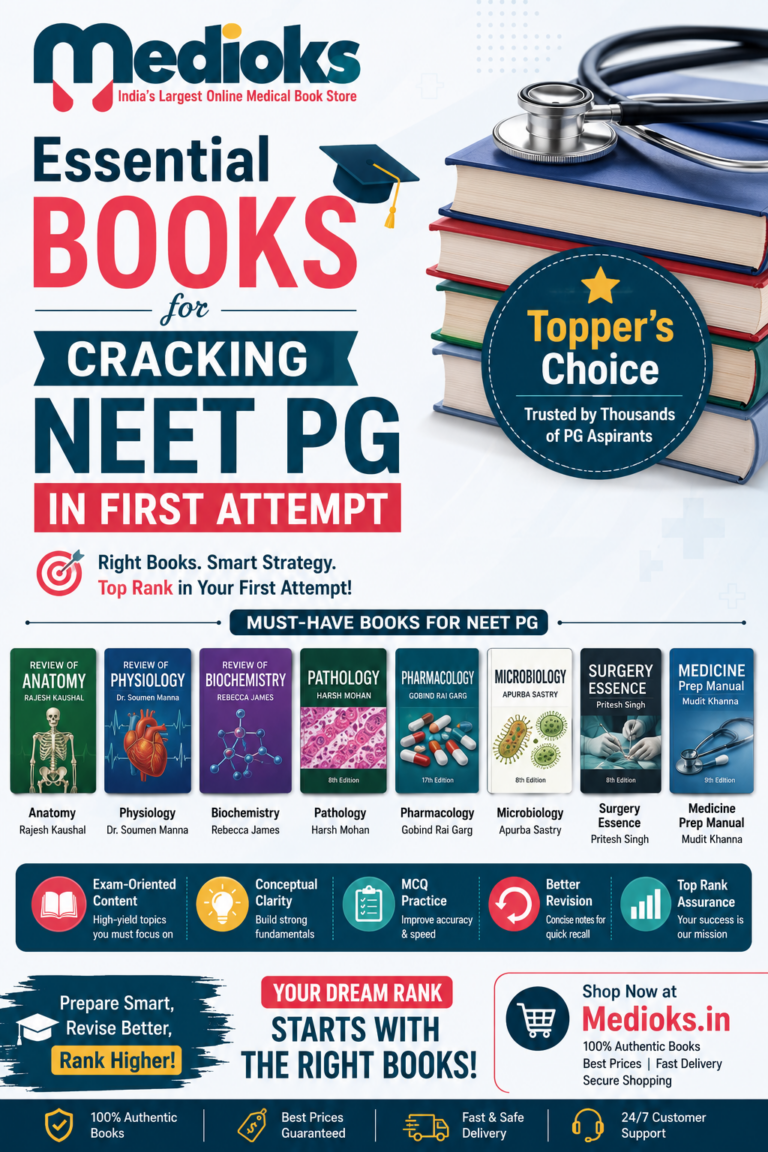
- Support NEET PG and NEXT preparation
- Develop evidence-based thinking
Choosing inappropriate resources can make learning unnecessarily difficult.
What Makes a Good MBBS Textbook?
Before purchasing any medical book, students should evaluate several key factors.
Conceptual Clarity
The best textbooks explain complex topics in simple and understandable language.
A book should help students understand concepts rather than memorize facts.
Clinical Relevance
Medicine is a practical profession.
Good textbooks connect theory with real-world clinical applications.
Examination Utility
University examinations remain an important part of MBBS.
The ideal book should cover frequently tested topics while maintaining conceptual depth.
Updated Content
Medical knowledge evolves continuously.
Students should always prefer recent editions containing updated guidelines and scientific developments.
Student-Friendly Presentation
Features such as:
- Flowcharts
- Diagrams
- Tables
- Clinical boxes
- Summary sections
significantly improve learning efficiency.
How to Choose Books for First-Year MBBS
The first year lays the foundation for the entire medical course.
Students typically study:
- Anatomy
- Physiology
- Biochemistry
Anatomy
Anatomy is one of the largest subjects in MBBS.
When selecting an anatomy textbook, look for:
- Clear diagrams
- Clinical correlations
- Structured organization
- Easy language
Many students prefer textbooks that balance examination preparation with conceptual understanding.
Physiology
Physiology focuses on understanding how the human body functions.
A good physiology textbook should include:
- Concept-based explanations
- Flowcharts
- Clinical applications
- Illustrative diagrams
Students should prioritize understanding over memorization.
Biochemistry
Biochemistry often feels challenging because of metabolic pathways and molecular concepts.
The best biochemistry books:
- Simplify pathways
- Include clinical correlations
- Use visual learning techniques
- Explain disease mechanisms
Choosing Books for Second-Year MBBS
The second year introduces subjects that bridge basic sciences and clinical medicine.
These include:
- Pathology
- Pharmacology
- Microbiology
Pathology
Pathology explains disease mechanisms.
An ideal pathology textbook should offer:
- Strong conceptual foundations
- Clinical relevance
- High-quality images
- Easy revision sections
Pharmacology
Students should look for pharmacology books that provide:
- Drug classifications
- Mechanisms of action
- Clinical uses
- Adverse effects
Understanding concepts is more important than memorizing drug names.
Microbiology
Microbiology plays a major role in both university examinations and postgraduate entrance tests.
A good microbiology book should include:
- Simplified explanations
- Diagnostic approaches
- Clinical relevance
- Updated infectious disease information
Selecting Books for Clinical Years
As students enter clinical subjects, textbook selection becomes even more important.
General Medicine
Medicine is often considered the backbone of clinical education.
An ideal medicine textbook should cover:
- Disease mechanisms
- Clinical presentations
- Investigations
- Treatment principles
Students should prioritize books that promote clinical reasoning.
Surgery
A surgery textbook should focus on:
- Surgical principles
- Clinical cases
- Procedures
- Decision-making
Practical understanding is essential.
Pediatrics
Pediatric textbooks should provide:
- Developmental concepts
- Pediatric diseases
- Growth milestones
- Clinical management
Obstetrics and Gynecology
A quality OBG textbook should balance:
- Conceptual understanding
- Clinical relevance
- Examination preparation
Students should focus on evidence-based and updated resources.
Should Students Buy Reference Books?
Many students believe they need every recommended textbook.
This is usually unnecessary.
A practical approach is:
Primary Textbook
Used for regular study and examinations.
Reference Book
Used only when additional clarification is needed.
This strategy prevents information overload.
Print Books vs Digital Resources
Modern students often combine traditional textbooks with digital learning tools.
Benefits of Printed Books
- Better concentration
- Easier annotation
- Reduced distractions
- Improved retention
Benefits of Digital Resources
- Portability
- Quick searches
- Interactive learning
- Multimedia content
The most effective students often use both.
Common Mistakes While Choosing MBBS Books
Buying Too Many Books
More books do not necessarily mean better learning.
Many students purchase multiple resources but fail to complete any of them.
Following Trends Blindly
A book that works well for one student may not work for another.
Choose resources that match your learning style.
Ignoring Faculty Recommendations
Experienced teachers understand examination patterns and curriculum requirements.
Their guidance is often valuable.
Choosing Only Exam Guides
Exam guides help with revision but cannot replace standard textbooks.
How AI Is Changing Medical Learning
Artificial intelligence tools are becoming increasingly popular among medical students.
AI can assist with:
- Study planning
- Revision notes
- Concept explanations
- Flashcard generation
However, AI should complement—not replace—standard textbooks.
Medical education requires evidence-based learning and clinical reasoning that develop through comprehensive study.
How to Identify Trustworthy Medical Books
Medical education belongs to a high-trust category where accuracy directly affects future patient care.
Students should evaluate books using E-E-A-T principles.
Experience
Books recommended by successful students, clinicians, and educators.
Expertise
Written by recognized experts in the field.
Authoritativeness
Widely accepted by medical colleges and institutions.
Trustworthiness
Evidence-based and regularly updated content.
Books that meet these standards provide the most reliable educational foundation.
Frequently Asked Questions
How many books should an MBBS student use for each subject?
One primary textbook and one optional reference book are usually sufficient.
Should first-year MBBS students buy all recommended books?
No. Focus on core textbooks that align with your curriculum and learning style.
Are digital resources enough for MBBS preparation?
Digital resources are helpful but should not completely replace standard textbooks.
Which is more important: textbooks or notes?
Textbooks build concepts, while notes help revision. Both are important.
Conclusion
Choosing the right MBBS books is one of the most important academic decisions a medical student can make. Rather than purchasing every available resource, students should focus on selecting a few high-quality textbooks that provide conceptual clarity, clinical relevance, and examination utility.
The best medical books are those that remain useful throughout MBBS, support postgraduate preparation, and help develop sound clinical reasoning. By following a structured approach, seeking guidance from experienced mentors, and prioritizing evidence-based resources, students can build a powerful medical library that supports long-term success.
Remember, success in MBBS is not about owning the most books—it’s about mastering the right ones.