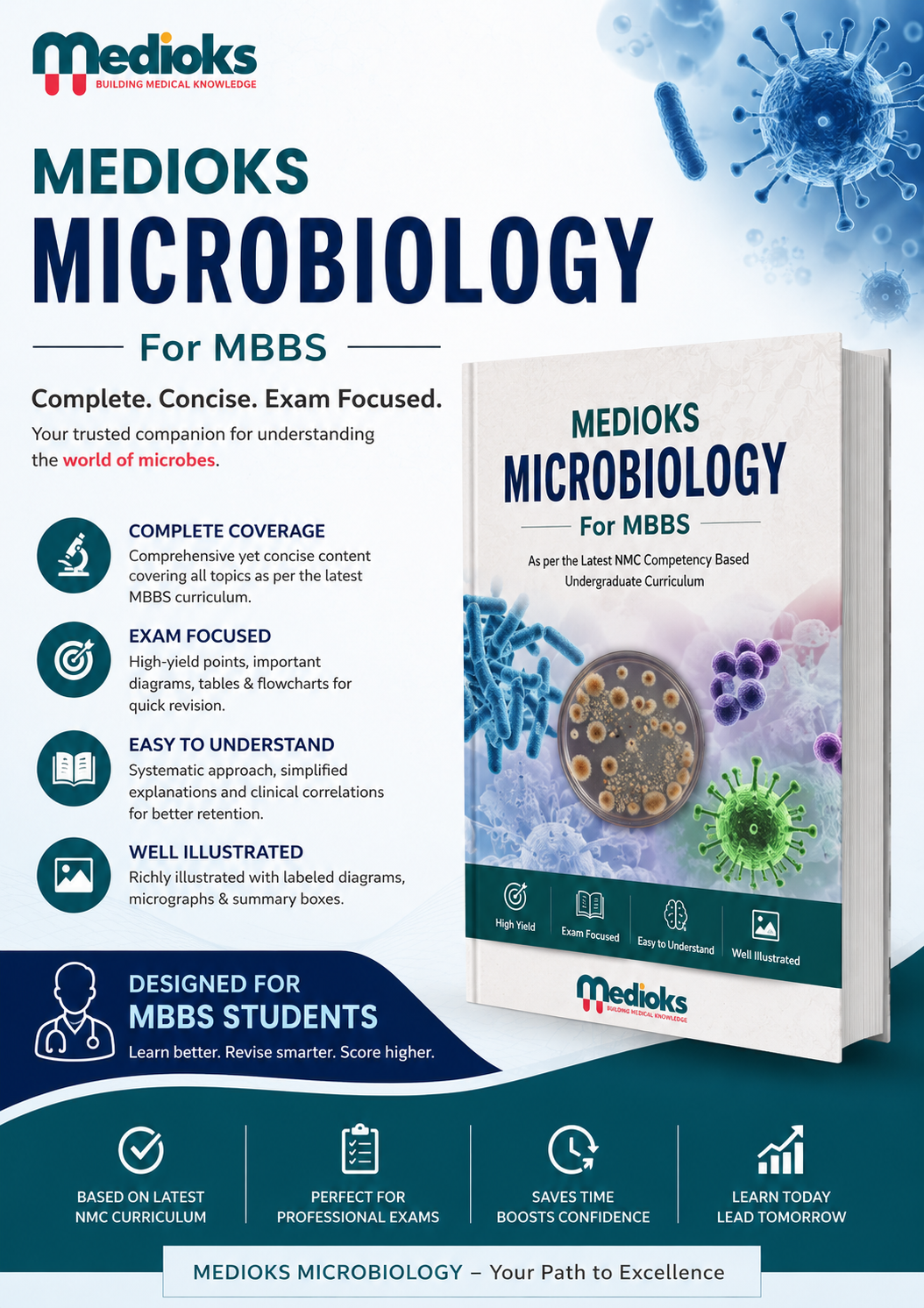
Printed vs eBooks for MBBS Microbiology: Which One Helps You Score Better?
The way medical students study has changed dramatically over the last decade. Traditional printed textbooks are now competing with digital eBooks, PDFs, online libraries, and mobile learning platforms. For MBBS students, especially those studying microbiology, choosing the right study format can significantly impact learning efficiency, revision speed, and examination performance.
One common question among second-year MBBS students is:
“Should I study microbiology from printed books or eBooks?”
Some students believe printed textbooks improve concentration and memory retention, while others prefer eBooks because of convenience and accessibility. With increasing academic pressure, understanding which format supports better performance has become more important than ever.
This guide explores the advantages, limitations, and practical implications of both printed microbiology books and eBooks, helping MBBS students choose the most effective learning strategy.
Quick Answer
If your goal is:
Better Memory Retention
Choose Printed Books
Faster Revision
Choose eBooks
University Exam Preparation
Printed books often provide better results.
Portability
eBooks are superior.
Long-Term Concept Building
Printed textbooks remain the preferred choice.
Best Strategy
Combine both formats for maximum efficiency.
Why Study Format Matters in MBBS
Microbiology is not simply a memorization-based subject.
Students must understand:
- Bacteriology
- Virology
- Immunology
- Mycology
- Parasitology
- Laboratory diagnosis
- Infection control
- Antimicrobial resistance
These topics require both conceptual understanding and repeated revision.
The study format you choose influences:
- Concentration
- Retention
- Note-making
- Revision speed
- Practical preparation
Understanding Printed Microbiology Books
Printed books refer to traditional hardcopy textbooks used in medical colleges.
Popular examples include:
- Apurba Sastry’s Essentials of Medical Microbiology
- Ananthanarayan and Paniker’s Textbook of Microbiology
- Baveja Textbook of Microbiology
These books have served generations of MBBS students and continue to be recommended by faculty members.
Benefits of Printed Books
Better Focus and Concentration
Physical books minimize distractions.
Students are less likely to switch between:
- Social media
- Messaging apps
- Notifications
- Entertainment platforms
This focused learning environment improves comprehension.
Enhanced Memory Retention
Research suggests that reading from printed materials often improves information retention.
Students frequently remember:
- Page locations
- Highlighted sections
- Diagrams
- Tables
This spatial memory advantage can be useful during examinations.
Effective Annotation
Printed textbooks allow students to:
- Highlight important points
- Add personal notes
- Mark frequently asked questions
- Create quick revision summaries
These annotations become valuable during exam preparation.
Better Understanding of Complex Topics
Subjects such as:
- Immunology
- Host-pathogen interactions
- Microbial genetics
- Antimicrobial resistance
often require uninterrupted reading.
Printed books support deeper engagement with these concepts.
Understanding eBooks
eBooks are digital versions of textbooks accessible through:
- Smartphones
- Tablets
- Laptops
- E-readers
They have become increasingly popular among MBBS students because of convenience and affordability.
Benefits of eBooks
Portability
Medical textbooks are often large and heavy.
With eBooks, students can carry multiple resources in a single device.
Instant Search Functionality
Searching terms such as:
- Tuberculosis
- Staphylococcus aureus
- Gram staining
takes only seconds.
This feature saves time during revision.
Cost Savings
Many eBooks cost less than printed textbooks.
Students can access several resources without making large investments.
Easy Accessibility
Students can study anywhere.
Whether commuting, traveling, or waiting between classes, eBooks provide instant access to learning materials.
Integration with Digital Learning
Many modern eBooks include:
- Interactive diagrams
- Hyperlinks
- Videos
- Self-assessment questions
These features can enhance understanding.
Printed Books vs eBooks: Direct Comparison
| Factor | Printed Books | eBooks |
|---|---|---|
| Retention | Excellent | Good |
| Portability | Moderate | Excellent |
| Annotation | Excellent | Good |
| Concentration | Excellent | Moderate |
| Searchability | Moderate | Excellent |
| Cost | Higher | Lower |
| Eye Comfort | Excellent | Moderate |
| Revision Speed | Good | Excellent |
| Concept Building | Excellent | Good |
| Accessibility | Moderate | Excellent |
Which Format Helps Students Score Better?
This is the most important question.
What Top Performers Usually Do
Most high-performing MBBS students do not rely exclusively on one format.
Instead, they use:
Printed Textbooks
For:
- Concept learning
- Note-making
- Deep reading
eBooks
For:
- Quick revision
- Topic searches
- Portable study sessions
This balanced approach maximizes learning efficiency.
University Exam Perspective
University examinations assess:
- Descriptive writing
- Clinical understanding
- Conceptual clarity
- Practical application
Students who study primarily from printed textbooks often perform better because they engage more deeply with the material.
Recommended Resources
- Apurba Sastry Microbiology
- Ananthanarayan Microbiology
- Practical Microbiology Manuals
These resources are particularly effective in printed format.
NEET PG Perspective
NEET PG preparation requires:
- Rapid revision
- High-yield recall
- MCQ practice
- Multiple references
In this context, eBooks provide significant advantages.
Students can:
- Search topics instantly
- Access multiple resources
- Study efficiently during spare time
However, strong concepts still originate from comprehensive textbook reading.
Common Mistakes Students Make
Depending Only on PDFs
Many students collect numerous PDFs but never study them systematically.
Ignoring Standard Textbooks
Summary notes cannot replace foundational learning.
Using Too Many Resources
Excessive resource collection often creates confusion.
Passive Reading
Whether using printed books or eBooks, active learning remains essential.
Students should:
- Highlight key points
- Create notes
- Practice questions
- Revise regularly
Best Hybrid Strategy for MBBS Students
Medical educators often recommend a hybrid learning model.
Step 1
Study theory from a printed textbook.
Step 2
Make handwritten notes.
Step 3
Use eBooks for quick revision.
Step 4
Review diagrams and practical topics digitally.
Step 5
Practice MCQs regularly.
This method combines the strengths of both formats.
Impact on Practical Examinations
Microbiology practicals require:
- Staining techniques
- Culture interpretation
- Laboratory procedures
- Viva preparation
Printed practical manuals often provide better learning experiences because students can annotate and review laboratory observations directly.
Future of Medical Learning
The future is unlikely to be exclusively digital or exclusively physical.
Medical education is moving toward blended learning.
Students increasingly combine:
- Printed textbooks
- eBooks
- Video lectures
- AI-assisted learning
- Online question banks
Success depends on using each resource appropriately.
Experience
Widely used by successful MBBS students.
Expertise
Written by recognized microbiology educators.
Authoritativeness
Recommended by medical colleges and faculty.
Trustworthiness
Evidence-based and regularly updated.
The quality of the content matters more than the format itself.
Frequently Asked Questions
Are eBooks enough for MBBS microbiology?
They can support learning, but most students benefit from using at least one standard printed textbook.
Which format improves memory retention?
Printed books generally provide stronger long-term retention.
Are eBooks useful for NEET PG?
Yes. Their portability and search functionality make them excellent revision tools.
Should I buy a printed microbiology textbook?
Yes. A standard textbook remains one of the most valuable investments for MBBS students.
Can I use both formats?
Absolutely. A hybrid approach often delivers the best academic results.
Conclusion
The debate between printed books and eBooks is not about choosing one winner. Both formats offer unique advantages that can support different stages of learning. Printed textbooks excel in concept building, focus, note-making, and long-term retention, while eBooks provide portability, accessibility, and rapid revision capabilities.
For MBBS microbiology, the most effective strategy is a combination of both. Use printed textbooks such as Apurba Sastry or Ananthanarayan for foundational learning and eBooks for revision and quick reference. This balanced approach helps students improve understanding, strengthen retention, and ultimately achieve better examination performance.