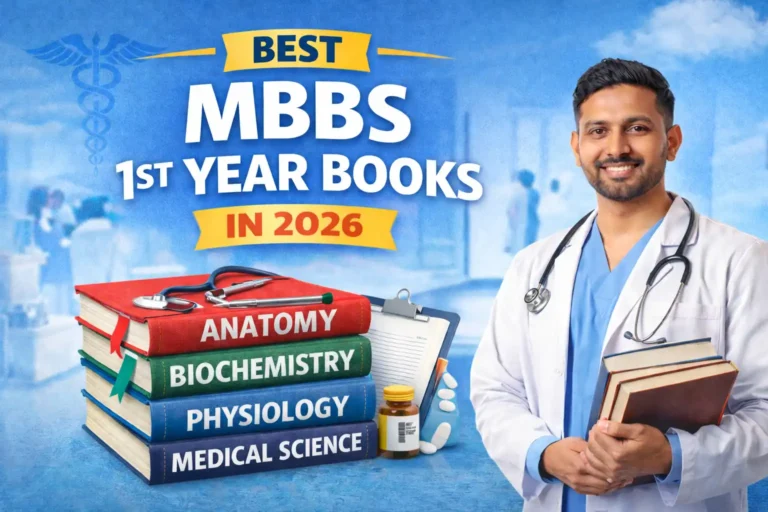
4th Year MBBS Books: Complete Subject-Wise Book List for Final Professional Part I Students (2026 Guide)
The fourth year of MBBS, often referred to as Final Professional Part I, is one of the most important phases of medical education. This academic year bridges the gap between pre-clinical learning and full-fledged clinical practice. Students are expected to develop strong diagnostic reasoning, improve patient communication skills, and master subjects that are frequently encountered during internship and postgraduate entrance examinations.
A common question among medical students is:
“Which are the best 4th year MBBS books?”
With multiple authors and editions available, selecting the right textbooks can be confusing. This guide provides a carefully curated subject-wise book list based on the latest National Medical Commission (NMC) Competency-Based Medical Education (CBME) curriculum, recommendations from experienced faculty, and the preferences of successful MBBS graduates.
Quick Answer
Best 4th Year MBBS Books
The most recommended textbooks include:
- Community Medicine: Park’s Textbook of Preventive and Social Medicine
- ENT: Dhingra’s Diseases of Ear, Nose and Throat
- ENT Reference: Zakir Hussain ENT
- Ophthalmology: Khurana Comprehensive Ophthalmology
- Reference Ophthalmology: Kanski Clinical Ophthalmology
These books provide an excellent balance between conceptual learning, clinical application, and university examination preparation.
Subjects Covered in 4th Year MBBS
According to the latest competency-based curriculum, fourth-year MBBS generally includes:
- Community Medicine (PSM)
- Ophthalmology
- Otorhinolaryngology (ENT)
Although the syllabus appears shorter than previous years, these subjects require both theoretical knowledge and clinical skills.
Best Community Medicine Book
Community Medicine focuses on preventive healthcare, epidemiology, national health programs, and public health management.
Park’s Textbook of Preventive and Social Medicine
This remains the gold standard for MBBS students across India.
Why it is recommended
- Covers the complete NMC syllabus
- Updated national health programmes
- Excellent epidemiology explanations
- Useful for MBBS university exams
- Helpful for NEET PG, INI-CET, and FMGE preparation
Topics include:
- Epidemiology
- Biostatistics
- Screening
- Vaccination
- Family planning
- Nutrition
- Occupational health
- Environmental health
Best ENT Books
ENT is one of the most clinically oriented subjects in fourth year.
Dhingra’s Diseases of Ear, Nose and Throat
One of the most widely used undergraduate textbooks.
Advantages
- Easy language
- Clinical illustrations
- Examination-oriented format
- Frequently asked viva topics
- Updated surgical concepts
The book explains common ENT disorders using practical clinical examples.
Zakir Hussain ENT
Many universities recommend Zakir Hussain’s ENT book because of its concise presentation.
Students appreciate it for:
- Simplified explanations
- Quick revision
- Viva preparation
- Short-answer questions
Many students use Dhingra as the primary textbook and Zakir Hussain for rapid revision.
Best Ophthalmology Books
Ophthalmology introduces students to common eye diseases and basic clinical examination techniques.
Khurana Comprehensive Ophthalmology
One of the most recommended undergraduate books.
Features
- Clinical photographs
- Systematic chapter organization
- Easy explanations
- Practical examination guidance
- Frequently asked university questions
The book covers:
- Anatomy of the eye
- Cataract
- Glaucoma
- Refractive errors
- Corneal diseases
- Retina
- Neuro-ophthalmology
Kanski Clinical Ophthalmology
Although considered a reference textbook, Kanski remains invaluable for deeper conceptual understanding.
Ideal for students interested in ophthalmology as a future specialty.
Recommended Book Combination
A balanced study combination includes:
Community Medicine
- Park’s Textbook of Preventive and Social Medicine
ENT
- Dhingra ENT
- Zakir Hussain ENT (Revision)
Ophthalmology
- Khurana Comprehensive Ophthalmology
- Kanski Clinical Ophthalmology (Reference)
This combination is sufficient for university examinations while also supporting postgraduate entrance preparation.
How to Study 4th Year MBBS Effectively
Unlike earlier years, fourth-year subjects demand both theoretical knowledge and clinical competence.
A productive study routine includes:
Morning
- Read one new topic.
Afternoon
- Attend clinics and observe patient examinations.
Evening
- Prepare short notes.
- Practice diagrams.
Night
- Solve previous university questions.
- Revise important clinical cases.
Consistent revision is more effective than studying everything before exams.
Clinical Skills to Focus On
Alongside textbooks, students should master practical skills.
Important clinical competencies include:
Community Medicine
- Health education
- Survey methods
- Vaccination schedules
- Epidemiological calculations
ENT
- Ear examination
- Tuning fork tests
- Nasal examination
- Laryngeal examination
Ophthalmology
- Visual acuity testing
- Fundus examination
- Eye movements
- Torchlight examination
Hands-on practice significantly improves confidence during practical examinations.
Common Mistakes Students Make
Many students lose marks because they:
- Depend only on lecture notes.
- Ignore clinical postings.
- Memorize without understanding.
- Skip previous-year university papers.
- Delay revision until the final month.
- Ignore practical examination preparation.
Regular clinical exposure helps reinforce theoretical learning.
How These Books Help in NEET PG
Fourth-year subjects contribute significantly to postgraduate entrance examinations.
Questions commonly appear from:
- Epidemiology
- National Health Programmes
- Screening tests
- Cataract
- Glaucoma
- ENT instruments
- Hearing tests
- Vestibular disorders
Using standard textbooks during MBBS builds a stronger foundation for competitive exams.
Frequently Asked Questions
Which book is best for Community Medicine?
Park’s Textbook of Preventive and Social Medicine is considered the standard undergraduate textbook across India.
Which ENT book is best?
Dhingra’s Diseases of Ear, Nose and Throat remains the most recommended MBBS textbook, while Zakir Hussain ENT is excellent for revision.
Which ophthalmology book is easiest?
Khurana Comprehensive Ophthalmology is preferred by most undergraduate students because of its simple language and exam-oriented presentation.
Are these books enough for university exams?
Yes. Combined with lecture notes, clinical postings, and previous-year papers, these textbooks adequately cover the NMC competency-based syllabus.
Should I buy reference books?
Reference books such as Kanski are beneficial for deeper learning but are not mandatory for passing university examinations.
Expert Tips for Fourth-Year MBBS Students
To perform well:
- Read standard textbooks consistently.
- Attend every clinical posting.
- Practice examination techniques regularly.
- Revise weekly.
- Solve previous university question papers.
- Prepare concise revision notes.
- Focus on clinical reasoning instead of rote memorization.
These habits will improve both university results and postgraduate entrance preparation.
Conclusion
Selecting the right 4th year MBBS books is essential for building clinical confidence and performing well in university examinations. Standard textbooks such as Park’s Textbook of Preventive and Social Medicine, Dhingra ENT, Zakir Hussain ENT, Khurana Comprehensive Ophthalmology, and Kanski Clinical Ophthalmology provide an ideal balance of conceptual clarity, clinical relevance, and exam-oriented preparation.
Instead of purchasing multiple books for every subject, focus on mastering one trusted textbook, attending clinical postings regularly, and revising consistently. A strong understanding of Community Medicine, ENT, and Ophthalmology will not only help you succeed in Final Professional Part I but also prepare you for internship and postgraduate entrance examinations.