Top AI-Powered Study Methods for MBBS Students: The Future of Medical Learning
Medical education is undergoing a revolutionary transformation. With the rise of Artificial Intelligence (AI), MBBS students now have access to smarter, faster, and more personalized learning methods than ever before. Traditional study techniques that relied solely on anatomy books for MBBS 1st year, physiology MBBS 1st year books, biochemistry books MBBS, and classroom lectures are now being enhanced by AI-powered tools that improve understanding, retention, and exam performance.
Today’s medical students face an overwhelming amount of information across subjects such as anatomy, physiology, biochemistry, pathology, pharmacology, microbiology, medicine, surgery, and clinical sciences. AI-powered learning solutions help students manage this vast syllabus efficiently while improving conceptual understanding and clinical reasoning.
Whether you are studying from MBBS syllabus books, revising microbiology books for MBBS, solving a medicine MCQ book, or preparing for NEXT and NEET PG, AI can significantly enhance your study strategy.
This comprehensive guide explores the top AI-powered study methods for MBBS students, their benefits, practical applications, and how they can complement traditional medical learning.
Why AI Is Transforming Medical Education
Medical students often struggle with:
- Information overload
- Time management
- Concept retention
- Revision planning
- Clinical correlation
- Competitive exam preparation
AI-powered learning systems address these challenges by providing:
- Personalized study plans
- Adaptive learning
- Instant explanations
- Smart flashcards
- Automated summaries
- Clinical case simulations
Rather than replacing traditional textbooks, AI helps students use them more effectively.
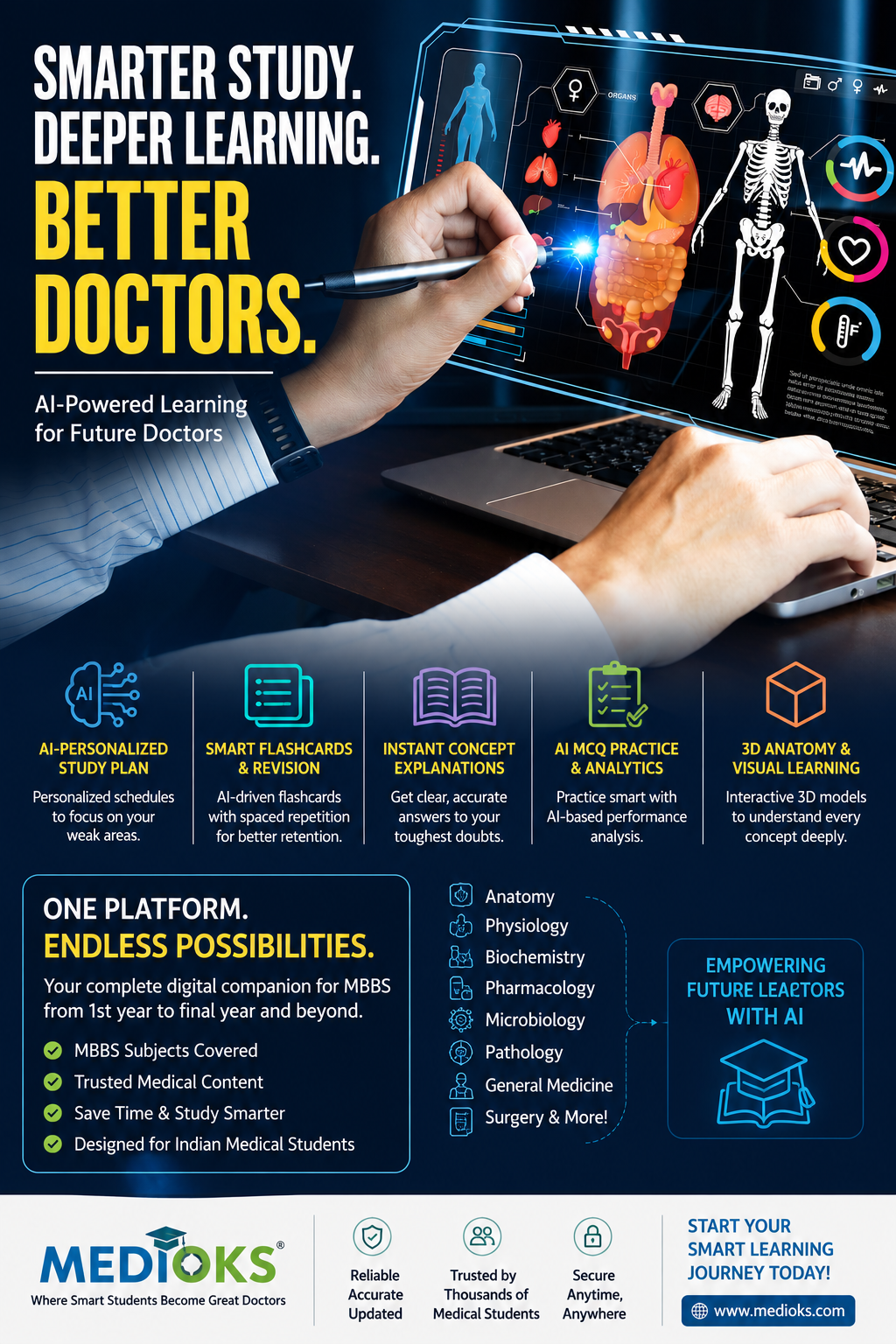
1. AI-Powered Personalized Study Plans
One of the biggest advantages of AI is personalized learning.
Traditional study methods often treat every student the same. AI systems analyze:
- Study patterns
- Performance data
- Weak subjects
- Revision frequency
- Learning speed
Based on this information, AI creates customized study schedules.
Example
If a student performs poorly in pharmacology but excels in anatomy, AI may recommend:
- Additional pharmacology revision sessions
- More MCQ practice
- Visual learning resources
- Spaced repetition schedules
This targeted approach improves efficiency significantly.
2. AI-Based Flashcards and Spaced Repetition
Medical education requires remembering thousands of facts.
Subjects such as:
- Anatomy
- Pharmacology
- Microbiology
- Biochemistry
often involve heavy memorization.
AI-powered flashcard systems use spaced repetition algorithms that determine:
- What to review
- When to review
- How frequently concepts should be revisited
This method improves long-term retention while reducing study time.
Useful Applications
Students studying:
- Anatomy book for MBBS 1st year
- Physiology MBBS 1st year book
- Biochemistry books MBBS
can convert notes into AI-generated flashcards for rapid revision.
3. AI for Summarizing Medical Textbooks
Many MBBS students spend hours reading lengthy chapters from:
- Pharmacy textbooks
- General medicine books for MBBS
- Microbiology books for 2nd year MBBS
- Medicine textbook MBBS
AI tools can summarize:
- Long chapters
- Research articles
- Clinical guidelines
- Lecture notes
These summaries help students:
- Save time
- Identify key concepts
- Focus on high-yield topics
However, AI-generated summaries should supplement—not replace—standard textbook reading.
- AI-Powered Clinical Case Learning
Modern medicine requires clinical reasoning, not just memorization.
AI-driven clinical simulators present:
- Virtual patients
- Clinical scenarios
- Diagnostic challenges
- Treatment decisions
Students can practice:
- Differential diagnosis
- Investigation interpretation
- Treatment planning
This approach bridges the gap between theory and clinical practice.
5. AI-Assisted MCQ Preparation
MCQ practice remains essential for:
- NEXT
- NEET PG
- FMGE
- INI-CET
AI-powered platforms can:
- Generate custom question banks
- Analyze mistakes
- Identify weak areas
- Recommend targeted revision
Students using a medicine MCQ book can combine traditional questions with AI analytics for better performance.
Benefits
- Faster revision
- Personalized feedback
- Improved exam readiness
- Better time management
- AI-Powered Anatomy Learning
Anatomy remains one of the most challenging subjects in first-year MBBS.
Students often depend on:
- Anatomy book for MBBS 1st year
- Atlas resources
- Cadaver dissections
AI-powered anatomy platforms now offer:
- 3D visualization
- Interactive organ models
- Virtual dissection
- Augmented reality learning
These technologies improve spatial understanding and concept retention.
7. AI for Pharmacology and Drug Learning
Pharmacology involves learning:
- Drug classifications
- Mechanisms of action
- Adverse effects
- Clinical indications
AI systems can create:
- Drug comparison tables
- Memory aids
- Clinical scenarios
- Personalized quizzes
Students studying pharmacy textbooks can use AI to simplify difficult pharmacological concepts and improve recall.
8. AI-Based Research Assistance
Evidence-based medicine is becoming increasingly important.
AI research tools help students:
- Search literature
- Summarize studies
- Identify key findings
- Organize references
This is especially useful for:
- Research projects
- Presentations
- Academic writing
- Journal clubs
Students can quickly understand complex research without spending excessive time reading lengthy papers.
9. AI for Microbiology and Pathology Revision
Subjects like microbiology and pathology involve large amounts of factual information.
Students often study from:
- Microbiology books for MBBS
- Microbiology books for 2nd year MBBS
- Pathology textbooks
AI can help by:
- Creating organism comparison charts
- Generating mnemonics
- Building image-based quizzes
- Simplifying disease mechanisms
Visual learning combined with AI significantly improves retention.
10. AI-Powered Voice Learning
Many students struggle to find study time during:
- Commutes
- Clinical postings
- Hospital duties
AI-powered voice tools can:
- Convert notes into audio
- Read textbook summaries
- Deliver quiz questions verbally
This allows students to continue learning while multitasking.
Best AI Study Practices for MBBS Students
Use AI as a Learning Assistant
AI should support—not replace—textbooks and faculty teaching.
Verify Medical Information
Always cross-check AI-generated information with:
- Standard textbooks
- Clinical guidelines
- Faculty recommendations
Prioritize Conceptual Understanding
AI tools are most effective when used for:
- Clarification
- Revision
- Practice
rather than memorization alone.
Combine AI with Standard Resources
Continue studying:
- Physiology MBBS 1st year book
- Biochemistry books MBBS
- General medicine books for MBBS
- MBBS 3rd year books
- Pharmacy textbooks
alongside AI-powered learning.
Common Mistakes Students Make with AI
Overdependence on Summaries
Students may miss deeper concepts.
Blindly Trusting AI Responses
Medical accuracy should always be verified.
Ignoring Standard Textbooks
Core medical knowledge still comes from established references.
Using Too Many Tools
A focused study strategy works best.
Future of AI in Medical Education
The future of medical learning will likely include:
- AI tutors
- Virtual patient simulations
- Personalized learning dashboards
- Predictive exam preparation
- Intelligent clinical training systems
Medical schools worldwide are already integrating AI into healthcare education, making digital literacy an important skill for future doctors.
Final Thoughts
Artificial Intelligence is reshaping how MBBS students learn, revise, and prepare for exams. From personalized study plans and AI-powered flashcards to virtual clinical simulations and research assistance, these tools offer powerful ways to enhance medical education.
However, the most effective strategy remains a combination of:
Standard MBBS syllabus books + Clinical exposure + Evidence-based learning + AI-powered study tools.
Students who successfully integrate AI with trusted resources such as anatomy books for MBBS 1st year, physiology MBBS 1st year books, biochemistry books MBBS, microbiology books for MBBS, general medicine books for MBBS, and medicine MCQ books will be better prepared for university exams, NEXT, NEET PG, and future clinical practice.
As medical education continues to evolve, AI is not replacing traditional learning—it is making it smarter, faster, and more personalized for the next generation of doctors.