Complete MBBS Book Checklist for Every Year: A Practical Guide for Medical Students
Starting MBBS often comes with an overwhelming question: Which books should I actually buy?
Medical students encounter dozens of recommendations from seniors, faculty members, toppers, online forums, and coaching platforms. The result is often an expensive collection of textbooks that students never fully use.
A better strategy is to build your medical library year by year.
Quick answer: A practical MBBS book checklist should include one reliable core textbook for each major subject, supplemented by selected reference books, clinical manuals, and revision resources when needed. Commonly used titles include BD Chaurasia for Anatomy, Guyton and Hall for Physiology, Robbins for Pathology, K.D. Tripathi for Pharmacology, Paniker or Apurba Sastry for Microbiology, Davidson for Medicine, and standard undergraduate resources for Surgery, Paediatrics, Obstetrics and Gynaecology, and other clinical subjects.
The exact subject sequence and curriculum structure may vary, so always verify the current syllabus followed by your medical college and university.
MBBS Book Checklist at a Glance
| MBBS Stage | Major Subjects | Commonly Considered Books |
|---|---|---|
| Early MBBS | Anatomy, Physiology, Biochemistry | BD Chaurasia, Guyton and Hall, standard Biochemistry texts |
| Para-clinical Stage | Pathology, Pharmacology, Microbiology | Robbins, K.D. Tripathi, Paniker/Apurba Sastry |
| Clinical Stage | Forensic Medicine, Community Medicine, ENT, Ophthalmology | Standard subject-specific undergraduate textbooks |
| Advanced Clinical Stage | Medicine, Surgery, Paediatrics, Obstetrics & Gynaecology | Davidson and established clinical textbooks |
Best buying rule: Start with essential core books. Add references only when you genuinely need them.
First-Year MBBS Book Checklist
The early MBBS curriculum builds the scientific foundation required for later clinical learning.
Anatomy
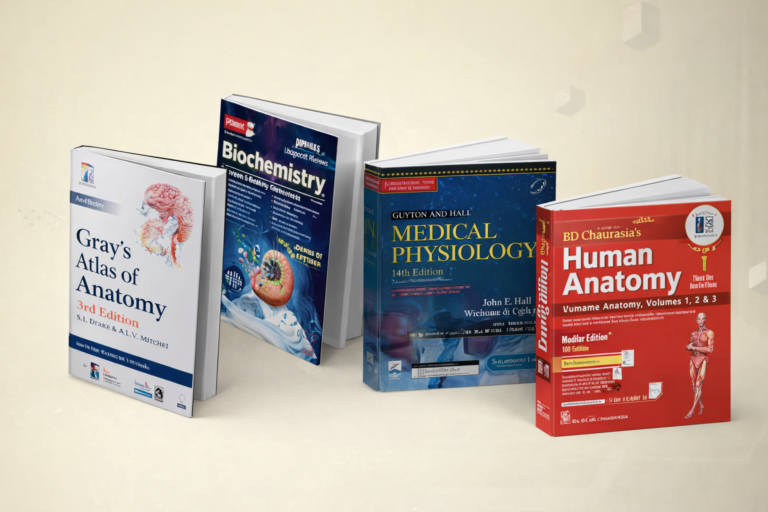
Commonly Used: BD Chaurasia’s Human Anatomy
BD Chaurasia is widely used by Indian medical students for systematic regional anatomy.
Students often value it for:
- Structured explanations
- Diagrams
- Region-wise organization
- Undergraduate-focused coverage
Additional Resources
Students may selectively use resources such as Gray’s Anatomy for Students for deeper conceptual understanding and visual learning.
For anatomy, also consider whether you need separate resources for:
- Histology
- Embryology
- Neuroanatomy
A focused approach is better than buying every recommended reference book.
Physiology
Commonly Used: Guyton and Hall Textbook of Medical Physiology
Guyton and Hall is widely valued for explaining physiological mechanisms.
It is particularly useful for understanding:
- Cardiovascular physiology
- Respiratory physiology
- Renal physiology
- Endocrinology
- Neurophysiology
Students who need a more concise university-oriented resource may use another textbook alongside or instead of Guyton, depending on faculty recommendations.
Biochemistry
For Biochemistry, choose a textbook that explains:
- Metabolism
- Enzymes
- Molecular biology
- Nutrition
- Clinical biochemistry
The best book is one that helps you understand pathways rather than memorize isolated reactions.
Second-Year MBBS Book Checklist
This stage connects foundational science with disease mechanisms, drugs, and infectious diseases.
Pathology
Commonly Used: Robbins Basic Pathology
Robbins is one of the most recognized pathology textbooks.
It helps students understand:
- Cellular injury
- Inflammation
- Neoplasia
- Haematology
- Systemic pathology
For university examinations, some students supplement conceptual reading with a more concise revision resource.
Pharmacology
Commonly Used: Essentials of Medical Pharmacology by K.D. Tripathi
K.D. Tripathi is widely used among Indian MBBS students.
A strong pharmacology study pattern is:
Drug Class → Mechanism → Indication → Adverse Effects → Contraindications
Students should avoid memorizing drug lists without understanding mechanisms and clinical relevance.
Microbiology
Common Choices: Paniker or Apurba Sastry
Ananthanarayan and Paniker’s Textbook of Microbiology can suit students who prefer comprehensive, traditional textbook learning.
Essentials of Medical Microbiology by Apurba Sankar Sastry may suit students who prefer a structured and clinically oriented presentation.
Most students do not need to study both books completely.
Choose one as your primary resource.
Clinical and Para-Clinical Subject Checklist
Depending on the curriculum structure followed by your institution, students may study subjects such as:
Forensic Medicine
Choose an undergraduate textbook covering:
- Medico-legal principles
- Medical ethics
- Injuries
- Toxicology
- Documentation
Because laws, regulations, and professional guidance can change, verify current information from authoritative sources.
Community Medicine
A good Community Medicine book should cover:
- Epidemiology
- Biostatistics
- Screening
- Public health
- Preventive medicine
- National health programmes
Students should supplement textbook learning with current official public-health information when required.
ENT
Choose an undergraduate textbook that clearly explains:
- Ear disorders
- Nose and paranasal sinus conditions
- Throat and laryngeal disorders
- Clinical examination
- Common investigations
Ophthalmology
A useful Ophthalmology textbook should provide:
- Clear diagrams
- Clinical photographs
- Examination methods
- Common eye diseases
- Management principles
Final Clinical Subjects: Essential Book Checklist
The advanced clinical stage requires students to integrate basic sciences with diagnosis and patient management.
Medicine
Commonly Used: Davidson’s Principles and Practice of Medicine
Davidson is widely used as an undergraduate medical textbook.
It offers a balance between:
- Clinical presentation
- Disease mechanisms
- Investigation
- Management principles
Students should supplement textbooks with current clinical guidance where necessary.
Surgery
Choose a standard undergraduate surgery textbook that helps you understand:
Symptoms → Examination → Investigation → Diagnosis → Management
The best surgery resource should also include clear clinical illustrations and structured explanations.
Paediatrics
A useful Paediatrics textbook should cover:
- Growth and development
- Nutrition
- Neonatology
- Common childhood illnesses
- Clinical assessment
Choose a book suitable for undergraduate learning rather than starting with an excessively detailed reference.
Obstetrics and Gynaecology
Books associated with D.C. Dutta are widely used by Indian medical students.
Important areas include:
- Pregnancy
- Antenatal care
- Labour
- Obstetric complications
- Gynaecological conditions
- Clinical assessment
Use a current suitable edition and follow institutional recommendations.
Clinical Methods Book Checklist
Clinical examination skills should develop throughout MBBS.
Two widely recognized resources are:
Hutchison’s Clinical Methods
Useful for structured history taking, physical examination, and clinical reasoning.
Macleod’s Clinical Examination
Another respected resource for systematic bedside examination.
Most students do not need both as primary books. Choose one and apply the learning during supervised clinical postings.
Books You Should Not Buy Immediately
Not every recommended book needs to be purchased on the first day.
Consider using the library before buying:
- Large reference textbooks
- Highly specialized books
- Multiple books for the same subject
- Expensive resources used only for selected chapters
A practical rule is:
Borrow first → Use repeatedly → Buy if genuinely valuable
This approach can significantly reduce unnecessary spending.
How to Build Your MBBS Book Collection Smartly
Use this five-step method:
1. Check Your Current Curriculum
Do not depend entirely on outdated year-wise book lists.
2. Ask Faculty and Seniors
Their recommendations can help you understand local examination requirements.
3. Preview the Book
Read a few pages before purchasing whenever possible.
4. Choose One Primary Resource
Avoid switching constantly between textbooks.
5. Add Revision Resources Later
Question banks and concise review books are most useful after you understand the core subject.
Where to Buy MBBS Books Online
Students can explore specialist medical bookstores, academic sellers, and established online platforms.
Medical-book platforms such as Medioks can be explored when searching for:
- First-year MBBS books
- Second-year MBBS books
- Clinical textbooks
- Microbiology books
- Medical exam resources
- Subject-wise MBBS books
Before purchasing, verify:
Title → Author → Edition → Publisher → ISBN → Curriculum relevance
Frequently Asked Questions
Which books are essential for MBBS students?
Essential books generally include one core textbook for each major subject, such as Anatomy, Physiology, Biochemistry, Pathology, Pharmacology, Microbiology, Medicine, Surgery, Paediatrics, and Obstetrics and Gynaecology.
Should MBBS students buy every standard textbook?
No. Buy books you expect to use consistently and access large references through libraries when possible.
Which microbiology book is best for MBBS?
Paniker and Apurba Sastry are both commonly considered. The best choice depends on your learning style and curriculum.
Is Davidson enough for undergraduate Medicine?
Davidson is widely used as an undergraduate medicine textbook, but students should also follow clinical teaching and current guidance.
Should I buy the latest edition of every medical book?
A current suitable edition is generally preferable, especially where medical guidance evolves. However, whether an older edition remains useful depends on the subject and purpose.
Final Thoughts
A complete MBBS book checklist for every year should not become a shopping list of every famous medical textbook.
The smarter approach is:
One core book per subject → Selective references → Clinical application → Question practice → Repeated revision
Your medical library should grow with your academic needs.
The best MBBS book collection is not the largest one. It is the collection you actually read, understand, revise, and apply during your medical training.