Dermatology Books Every Medical Student Should Read: A Complete 2026 Guide
Dermatology is one of the most visually driven specialties in medicine. A rash, plaque, papule, vesicle, pigmentary change, or nail abnormality may provide crucial diagnostic clues—but only if you know how to observe and interpret them correctly.
For medical students, the challenge is choosing a dermatology book that balances clinical photographs, concise theory, diagnostic reasoning, treatment principles, and exam-oriented learning.
So, which dermatology books should every medical student read?
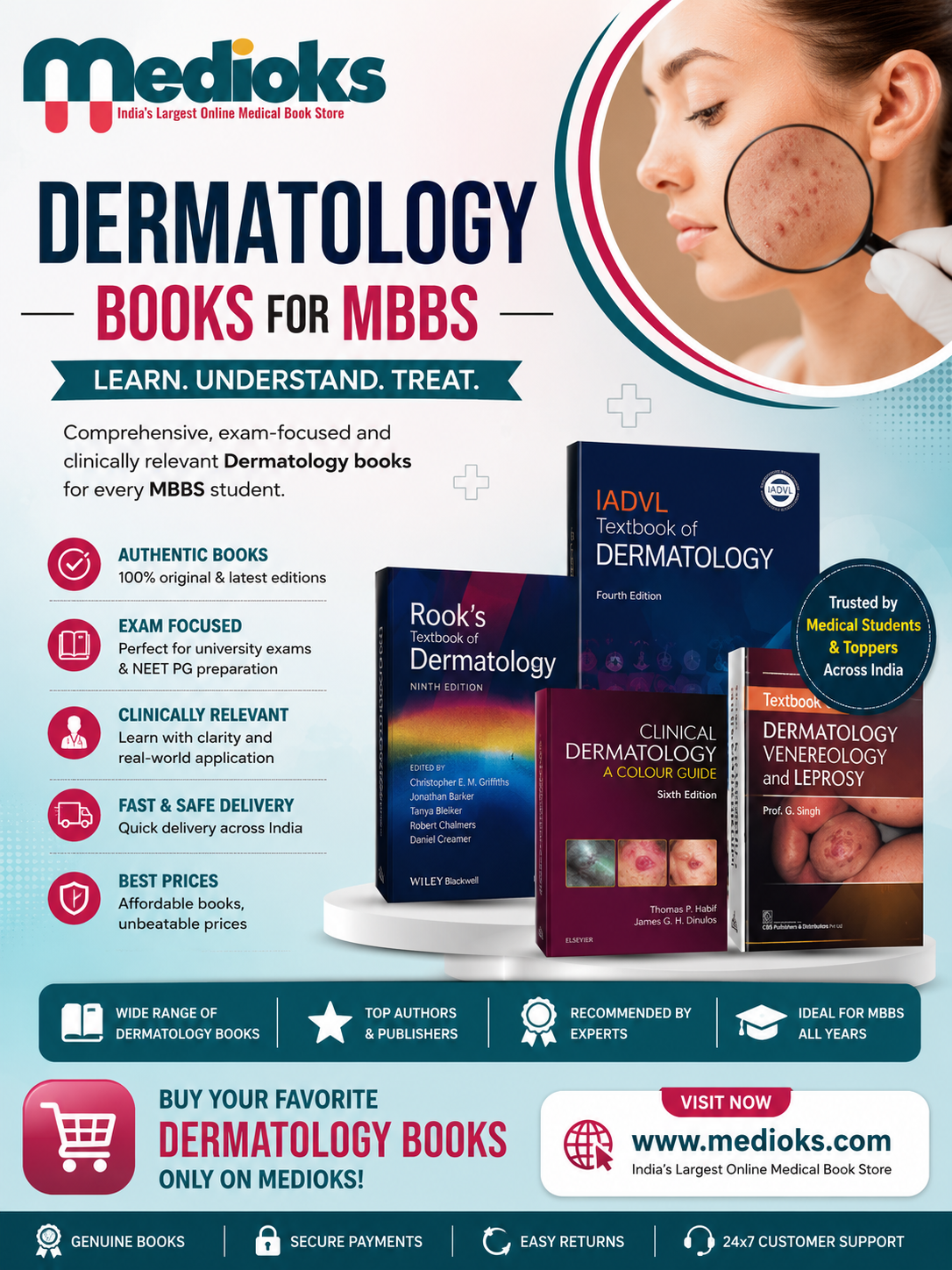
For most MBBS students, the best strategy is to use one core undergraduate dermatology textbook, supported by a visual atlas or clinical reference when deeper image-based learning is required. Books such as IADVL Textbook of Dermatology, Rook’s Textbook of Dermatology, Fitzpatrick’s Dermatology, Clinical Dermatology by Thomas P. Habif, and concise undergraduate-focused texts can serve different learning needs.
The best choice depends on whether your goal is MBBS university examinations, clinical postings, postgraduate entrance preparation, or advanced dermatology study.
Quick Answer: Best Dermatology Books for Medical Students
Popular dermatology resources include:
- IADVL Textbook of Dermatology – Comprehensive reference with relevance to Indian clinical practice.
- Rook’s Textbook of Dermatology – Advanced and detailed reference.
- Fitzpatrick’s Dermatology – In-depth academic and scientific reference.
- Clinical Dermatology by Thomas P. Habif – Strong clinical and visual approach.
- Illustrated Synopsis of Dermatology & Sexually Transmitted Diseases by Neena Khanna – Popular among Indian undergraduate medical students.
- ABC of Dermatology – Concise introductory resource.
No single book is ideal for every student. Choose according to your academic level and purpose.
Why Medical Students Need a Good Dermatology Book
Dermatology cannot be mastered through memorization alone.
Students need to develop the ability to:
- Describe skin lesions accurately.
- Recognize primary and secondary lesions.
- Identify common disease patterns.
- Take a focused dermatological history.
- Perform a systematic examination.
- Build differential diagnoses.
- Understand basic treatment principles.
- Recognize dermatological emergencies.
A good textbook connects what a disease looks like with why it occurs and how it is managed.
1. Illustrated Synopsis of Dermatology & Sexually Transmitted Diseases by Neena Khanna
For many Indian MBBS students, this is a practical undergraduate-focused option.
The book is designed to make dermatology approachable through concise explanations and visual learning.
Best For
- MBBS students
- University exam preparation
- Clinical postings
- Quick revision
Why Students Consider It
Its relatively concise structure can make it easier to cover important undergraduate topics without becoming overwhelmed by specialist-level detail.
It can be especially useful for learning:
- Common skin disorders
- Sexually transmitted infections
- Leprosy
- Clinical features
- Differential diagnosis
- Basic management principles
Verdict: A strong choice for students seeking an exam-oriented and undergraduate-friendly dermatology resource.
2. IADVL Textbook of Dermatology
The IADVL Textbook of Dermatology is a comprehensive resource associated with dermatology practice and education in India.
It provides broader and deeper coverage than most concise undergraduate books.
Best For
- Students seeking deeper understanding
- Postgraduate learners
- Residents
- Advanced reference
Key Strength
Its major advantage is comprehensive subject coverage with relevance to dermatological conditions encountered in Indian clinical settings.
For a busy undergraduate student, however, it may be more detailed than necessary for routine university examination preparation.
Verdict: Excellent as a comprehensive reference, particularly for advanced learners and students with a strong interest in dermatology.
3. Clinical Dermatology by Thomas P. Habif
Dermatology is highly visual, and Clinical Dermatology is known for connecting clinical presentation with diagnosis and management.
Best For
- Visual learners
- Clinical reasoning
- Differential diagnosis
- Students interested in dermatology
A clinically oriented book can help students move beyond memorizing disease descriptions and begin recognizing patterns.
Verdict: A valuable clinical reference for students who want stronger image-based and diagnostic learning.
4. Rook’s Textbook of Dermatology
Rook’s Textbook of Dermatology is a major specialist reference.
It offers extensive coverage of dermatological science, disease mechanisms, diagnosis, and management.
Best For
- Dermatology residents
- Postgraduate students
- Researchers
- Advanced academic reference
For most MBBS students, reading Rook’s from cover to cover is neither necessary nor time-efficient. However, it can be valuable when researching a difficult topic in greater depth.
Verdict: An authoritative advanced reference rather than a primary undergraduate exam book.
5. Fitzpatrick’s Dermatology
Fitzpatrick’s Dermatology is another internationally recognized reference for advanced dermatological study.
It covers areas such as:
- Disease mechanisms
- Clinical manifestations
- Diagnostic principles
- Dermatological science
- Therapeutic approaches
Best For
- Advanced learners
- Postgraduate trainees
- Academic reference
- Students considering dermatology as a specialty
Like Rook’s, it contains considerably more detail than most undergraduate students need for routine MBBS examinations.
Verdict: Best used selectively by medical students and more extensively during postgraduate dermatology training.
6. ABC of Dermatology
Students looking for a concise introduction may find ABC of Dermatology useful.
Its accessible approach can help beginners understand:
- Common skin diseases
- Basic lesion recognition
- Clinical presentations
- Fundamental management principles
Best For
- Beginners
- Quick conceptual review
- Introductory dermatology learning
Verdict: A useful supplementary resource, particularly for students beginning their dermatology clinical exposure.
Which Dermatology Book Is Best for MBBS University Exams?
For university examinations, a concise book aligned with the undergraduate curriculum is generally more practical than a specialist reference.
An effective combination can be:
Primary undergraduate textbook + lecture notes + clinical exposure + previous-year questions
For Indian MBBS students, a concise undergraduate-focused text such as Neena Khanna’s dermatology book is often considered more manageable for examination preparation, while larger references can be consulted selectively.
Always prioritize your university syllabus and faculty recommendations.
Which Book Is Best for Clinical Dermatology?
Clinical competence requires more than theoretical reading.
A useful clinical resource should provide:
- High-quality clinical photographs
- Morphological descriptions
- Differential diagnoses
- Diagnostic clues
- Management principles
Books such as Clinical Dermatology by Habif can support visual learning, while comprehensive references such as IADVL, Rook’s, and Fitzpatrick’s can provide deeper explanations when required.
Most importantly, combine reading with supervised clinical exposure.
How to Study Dermatology from a Textbook
Do not read dermatology like a purely theoretical subject.
Use this framework for each condition:
Definition → Etiology → Pathogenesis → Morphology → Distribution → Clinical Features → Differential Diagnosis → Investigations → Management
While studying a disease, ask:
- What is the primary lesion?
- Where does it usually appear?
- What is the typical distribution?
- Is it itchy or painful?
- What are the important differentials?
- Which investigation confirms the diagnosis?
- What are the basic management principles?
This approach develops clinical reasoning rather than isolated memorization.
How Many Dermatology Books Does an MBBS Student Need?
Usually, one good primary textbook is enough.
You can supplement it with:
- Clinical photographs and atlases
- Faculty notes
- Current clinical guidelines
- Previous-year university questions
- Reliable medical references
Buying several large textbooks often creates resource overload. The better strategy is to master one core resource and consult advanced references selectively.
Where to Buy Dermatology Books Online
When purchasing medical textbooks, verify:
- Correct title and author
- Latest available edition
- Publisher details
- Book format
- Seller authenticity
Students looking for dermatology textbooks for MBBS, standard medical references, and other specialty books can explore relevant titles through Medioks, which focuses on medical and healthcare education books.
Always confirm the exact edition and syllabus requirements before purchasing.
Frequently Asked Questions
Which is the best dermatology book for MBBS students?
The best choice depends on your curriculum and learning style. Concise undergraduate-focused books are generally more practical for university examinations, while comprehensive references are better for deeper study.
Is Rook’s Dermatology suitable for MBBS students?
Yes, but it is highly detailed. Most MBBS students will find it more useful as a selective reference rather than a primary exam textbook.
Is Fitzpatrick’s Dermatology good for beginners?
It is an advanced reference. Beginners may benefit more from a concise undergraduate textbook before moving to specialist-level resources.
How should I study dermatology for exams?
Focus on lesion morphology, clinical features, differential diagnosis, investigations, and basic management. Use clinical images and practice writing structured answers.
Do medical students need a dermatology atlas?
An atlas is not always essential, but high-quality clinical images can significantly improve visual recognition and pattern-based learning.
Final Thoughts
The best dermatology books for medical students are not necessarily the largest or most detailed. The right book is the one that matches your academic level, curriculum, and learning objective.
For most MBBS students, start with a concise undergraduate textbook that supports exam preparation and clinical postings. Use resources such as IADVL, Rook’s, Fitzpatrick’s, or Habif selectively when you need greater depth or stronger clinical correlation.
Most importantly, remember that dermatology is learned through a combination of reading, observing, describing, comparing, and clinically reasoning through skin lesions.
Choose one reliable core book, study consistently, use clinical images actively, and connect every chapter with real patient findings whenever possible.