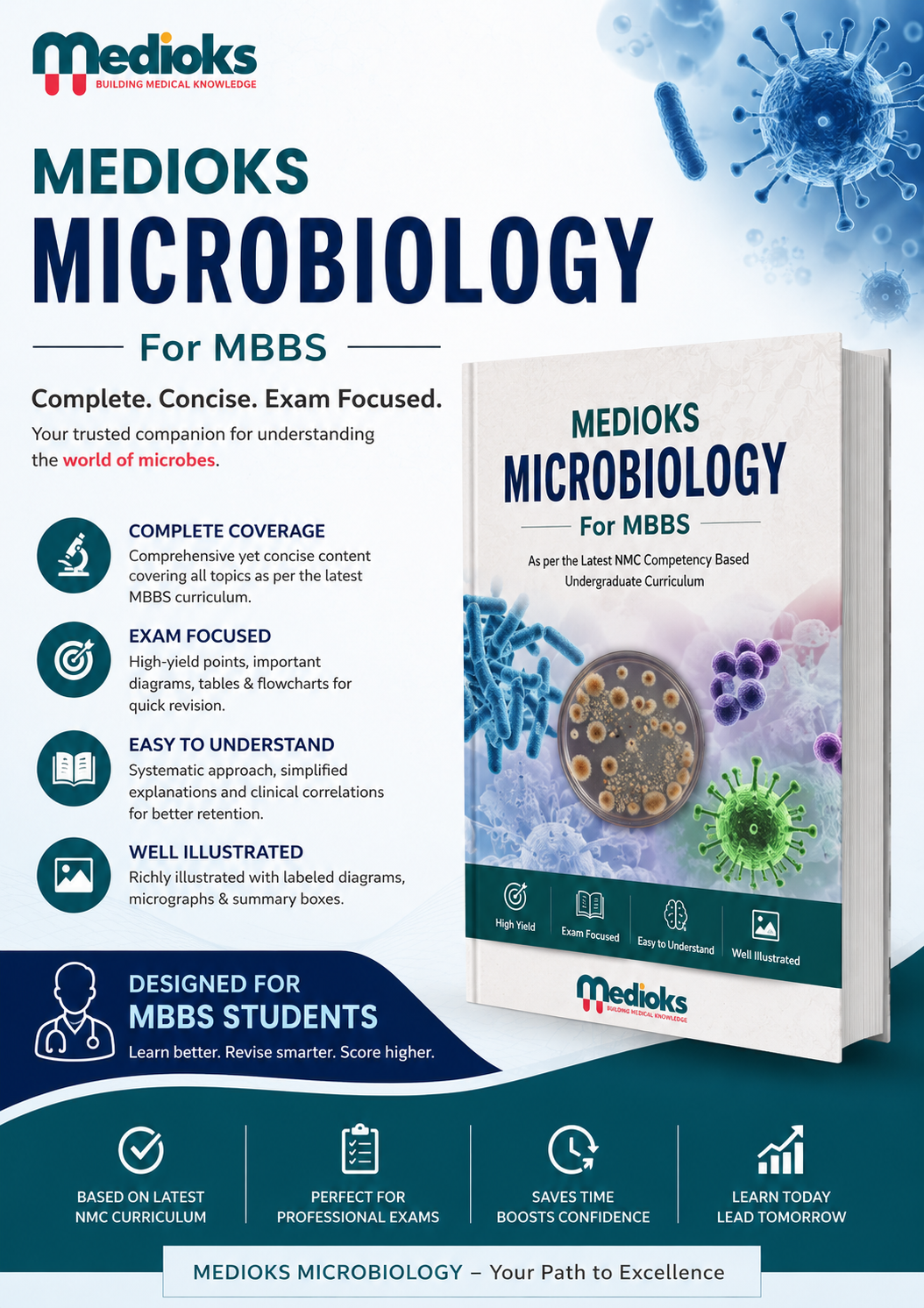
How to Study Microbiology in MBBS Without Memorizing Everything: A Smarter Learning Guide for Medical Students
Microbiology is often considered one of the most memory-intensive subjects in MBBS. From bacteria and viruses to fungi, parasites, toxins, culture media, and laboratory diagnosis, the syllabus can seem endless. Many medical students spend hours trying to memorize facts only to forget them during exams or clinical postings.
The good news is that successful MBBS students don’t memorize everything. Instead, they use structured learning methods that focus on understanding patterns, disease mechanisms, and clinical applications.
If you’ve ever wondered:
- How can I study microbiology faster?
- Do I need to memorize every microorganism?
- How do NEET PG toppers remember microbiology?
- Is there a smarter way to learn microbiology?
This guide will show you evidence-based strategies to master microbiology without overwhelming memorization while improving both university exam performance and NEET PG preparation.
Quick Answer: Can You Study Microbiology Without Memorizing Everything?
Yes.
Microbiology becomes much easier when you focus on:
- Understanding disease mechanisms
- Learning patterns instead of isolated facts
- Using clinical correlations
- Practicing active recall
- Creating visual memory maps
- Revising strategically
The goal is not to memorize every detail but to understand how microorganisms cause disease and how they are diagnosed, treated, and prevented.
Why Students Struggle With Microbiology
Many MBBS students approach microbiology incorrectly.
Common mistakes include:
- Memorizing textbook paragraphs
- Learning organisms individually
- Ignoring clinical applications
- Studying only before exams
- Using passive reading methods
As a result, information is quickly forgotten.
Microbiology becomes easier when students understand the logic behind infections rather than treating the subject as a collection of facts.
Shift From Memorization to Understanding
One of the biggest breakthroughs in medical learning occurs when students stop asking:
“What should I memorize?”
and start asking:
“Why does this happen?”
For example:
Instead of memorizing that Staphylococcus aureus causes abscesses, understand:
- How it enters the body
- What toxins it produces
- How the immune system responds
- Why abscesses form
- Which antibiotics are effective
Once you understand the mechanism, remembering the facts becomes much easier.
Study Microbiology Through Clinical Cases
Clinical correlation is one of the most effective learning methods.
Rather than studying microorganisms in isolation, connect them to patient scenarios.
Example
A patient presents with:
- Fever
- Productive cough
- Chest pain
- Lung consolidation
Instead of recalling a list of bacteria, think:
- Which organisms commonly cause pneumonia?
- What investigations confirm the diagnosis?
- What treatment is appropriate?
This approach mirrors how questions appear in university exams and NEET PG.
Use Disease-Based Learning
Many students learn microbiology organism by organism.
A more effective approach is disease-based learning.
Instead of studying:
- Staphylococcus
- Streptococcus
- Klebsiella
Study:
Pneumonia
Then compare:
- Causative organisms
- Symptoms
- Diagnosis
- Treatment
This creates connections between concepts and improves long-term retention.
Focus on High-Yield Concepts
Not every topic carries equal importance.
Prioritize:
Immunology
- Hypersensitivity reactions
- Vaccines
- Immune deficiencies
Bacteriology
- Tuberculosis
- Staphylococcus
- Streptococcus
Virology
- HIV
- Hepatitis viruses
- Herpes viruses
Parasitology
- Malaria
- Leishmaniasis
Sterilization and Disinfection
Frequently tested in university exams and NEET PG.
Studying high-yield areas first improves efficiency.
Create Microbiology Flowcharts
Visual learning significantly reduces the need for rote memorization.
Instead of reading lengthy paragraphs, create flowcharts.
Example
Tuberculosis
Exposure → Infection → Granuloma Formation → Symptoms → Diagnosis → Treatment
Flowcharts simplify complex information and improve recall during exams.
Use Active Recall Instead of Re-Reading
Research consistently shows that active recall is superior to passive reading.
Passive Reading
Reading the same chapter repeatedly.
Active Recall
Closing the book and answering questions from memory.
Examples:
- What are the virulence factors of Staphylococcus aureus?
- Which tests diagnose typhoid fever?
- What vaccines contain live attenuated organisms?
Active recall strengthens memory and highlights knowledge gaps.
Apply Spaced Repetition
One reason students forget microbiology is poor revision timing.
Spaced repetition involves reviewing information at increasing intervals.
Suggested Schedule
- Day 1
- Day 3
- Day 7
- Day 14
- Day 30
This technique dramatically improves long-term retention.
Learn Through Tables and Comparisons
Microbiology contains many similar organisms.
Comparison tables reduce confusion.
Example
| Feature | Staphylococcus | Streptococcus |
|---|---|---|
| Arrangement | Clusters | Chains |
| Catalase | Positive | Negative |
| Common Diseases | Abscesses | Pharyngitis |
Tables improve understanding and save revision time.
Use Standard MBBS Microbiology Textbooks Wisely
A common mistake is studying multiple books simultaneously.
Instead:
Primary Book
Use one standard textbook consistently.
Reference Book
Consult additional resources only when needed.
Popular choices include:
- Apurba Sastry’s Essentials of Medical Microbiology
- Ananthanarayan and Paniker’s Textbook of Microbiology
- Jawetz Medical Microbiology
Mastering one book is more effective than partially reading several.
Integrate Microbiology With Other Subjects
Microbiology does not exist in isolation.
Connect it with:
Pathology
Disease mechanisms
Pharmacology
Antibiotics and antimicrobial resistance
Medicine
Clinical manifestations
Pediatrics
Vaccination schedules
Community Medicine
Disease prevention and public health
Integration creates meaningful learning and reduces memorization.
Solve MCQs While Studying
Many students postpone MCQs until exam season.
This is a mistake.
MCQs help:
- Reinforce concepts
- Identify weak areas
- Improve application skills
- Enhance retention
Regular question practice transforms passive learning into active learning.
Can AI Help You Learn Microbiology Better?
AI tools are increasingly being used by MBBS students.
They can assist with:
- Simplified explanations
- Clinical case discussions
- Flashcard generation
- Personalized quizzes
- Revision plans
However, AI should supplement—not replace—standard microbiology textbooks and faculty guidance.
The most effective strategy combines trusted resources with modern technology.
Common Mistakes to Avoid
Memorizing Entire Chapters
Focus on concepts first.
Ignoring Immunology
Immunology forms the foundation of microbiology.
Studying Without Revision
Retention depends on repeated exposure.
Using Too Many Resources
One primary textbook is sufficient for most students.
Avoiding Clinical Correlation
Microbiology becomes meaningful when linked to patient care.
Why Concept-Based Learning Matters
Medical education falls under Google’s YMYL (Your Money or Your Life) category, where accuracy and expertise are critical.
Effective learning should be based on:
Experience
Learning from clinical examples.
Expertise
Using textbooks written by recognized specialists.
Authoritativeness
Following established medical curricula.
Trustworthiness
Relying on evidence-based information.
These principles help students build reliable and clinically relevant knowledge.
Frequently Asked Questions
Do I need to memorize every microorganism in MBBS?
No. Focus on understanding disease mechanisms, clinical relevance, and high-yield organisms.
What is the easiest way to study microbiology?
Use clinical correlation, flowcharts, active recall, and spaced repetition.
Which microbiology book is best for understanding concepts?
Apurba Sastry is widely considered one of the most student-friendly options.
How do NEET PG toppers study microbiology?
Most focus on concepts, repeated revision, MCQ practice, and integrated learning rather than rote memorization.
Can AI tools help in microbiology preparation?
Yes, but they should be used alongside standard textbooks and faculty teaching.
Conclusion
Microbiology does not have to be a subject of endless memorization. The most successful MBBS students learn microbiology by understanding patterns, linking concepts to clinical cases, practicing active recall, and revising strategically. By focusing on disease mechanisms rather than isolated facts, students can retain information longer, perform better in university examinations, and build a strong foundation for NEET PG and future clinical practice.