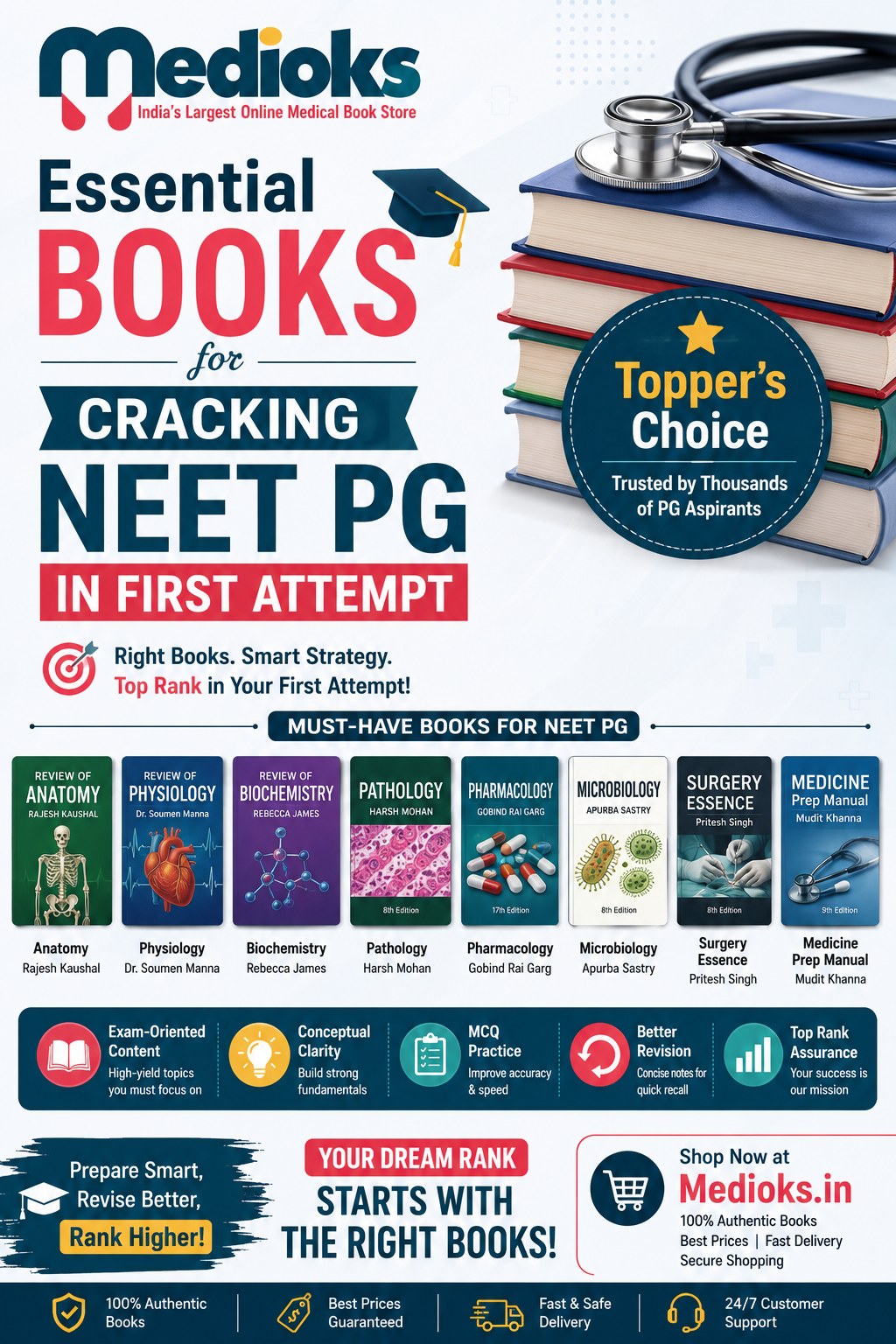
Best Question Banks for NEET PG Preparation (2026 Guide): How to Choose the Right QBank for Success
Preparing for the National Eligibility cum Entrance Test for Postgraduate (NEET PG) is one of the most demanding phases in a medical student’s journey. With thousands of aspirants competing for limited postgraduate seats, success depends on much more than reading standard MBBS textbooks. A structured preparation strategy requires consistent revision, conceptual clarity, and extensive practice through high-quality NEET PG question banks (QBanks).
Question banks have become one of the most valuable preparation resources because they help students apply theoretical knowledge, identify weak areas, and become familiar with the pattern of multiple-choice questions. However, with numerous printed and digital QBanks available, many aspirants ask:
“Which is the best question bank for NEET PG preparation?”
The answer depends on your learning style, current preparation level, and study goals. Instead of relying on a single resource, the best strategy is to choose a trusted, updated QBank that complements your standard textbooks and revision notes.
This guide explains what makes a good NEET PG QBank, the features you should prioritize, common mistakes to avoid, and how to build an effective preparation strategy using question banks.
Quick Answer: Which Is the Best Question Bank for NEET PG?
The best NEET PG question bank is one that:
- Covers the complete MBBS curriculum.
- Includes updated, exam-oriented MCQs.
- Provides detailed explanations for every answer.
- Follows the latest NEET PG pattern.
- Includes image-based and clinical scenario questions.
- Offers subject-wise and integrated practice.
- Supports revision with concise explanations.
Rather than selecting the largest QBank, choose one that emphasizes concept-building and evidence-based explanations.
Why Question Banks Are Essential for NEET PG Preparation
Reading textbooks alone is not enough for a competitive examination like NEET PG.
Question banks help you:
- Apply theoretical concepts.
- Improve clinical reasoning.
- Identify frequently tested topics.
- Increase speed and accuracy.
- Strengthen recall under exam conditions.
- Practice integrated thinking across subjects.
- Build confidence before the examination.
They transform passive reading into active learning, which significantly improves long-term retention.
Features of a High-Quality NEET PG Question Bank
1. Comprehensive Subject Coverage
A reliable QBank should include questions from all major MBBS subjects, ensuring balanced preparation across pre-clinical, para-clinical, and clinical disciplines.
This prevents students from focusing excessively on only a few high-scoring subjects.
2. Detailed Answer Explanations
Correct answers alone are not enough.
The best QBanks explain:
- Why the correct option is right.
- Why other options are incorrect.
- Related clinical concepts.
- Recent guideline updates where applicable.
These explanations strengthen conceptual understanding rather than encouraging rote memorization.
3. Clinical Scenario-Based Questions
Modern NEET PG examinations increasingly emphasize clinical application rather than factual recall.
A strong QBank should contain:
- Patient case scenarios.
- Diagnostic reasoning questions.
- Investigation-based MCQs.
- Treatment-oriented problems.
This prepares students for real examination patterns.
4. Image-Based Questions
Image interpretation has become increasingly important.
Look for QBanks that include:
- Radiographs.
- Histopathology slides.
- ECGs.
- Clinical photographs.
- Gross pathology images.
Practicing image-based questions improves visual diagnostic skills.
5. Updated Content
Medical science evolves continuously.
Choose QBanks that reflect:
- Current clinical guidelines.
- Updated disease classifications.
- Revised treatment recommendations.
- Recent examination trends.
Updated resources reduce the risk of studying outdated information.
Printed Question Banks vs Digital QBanks
Both formats have unique advantages.
Printed QBanks
Benefits include:
- Better concentration.
- Easy annotation.
- Reduced screen fatigue.
- Convenient offline study.
Many students prefer printed resources during revision.
Digital QBanks
Useful for:
- Adaptive practice.
- Performance analytics.
- Timed mock tests.
- Anywhere access.
- Personalized revision.
Many successful candidates combine both printed and digital resources.
How to Use a NEET PG Question Bank Effectively
Owning a QBank is not enough—how you use it matters.
Step 1: Read the Concept First
Study the topic from your standard textbook or concise notes before attempting questions.
Step 2: Solve MCQs Without Guessing
Attempt questions honestly to identify genuine strengths and weaknesses.
Step 3: Review Every Explanation
Read explanations for both correct and incorrect answers. This reinforces learning and corrects misconceptions.
Step 4: Maintain an Error Notebook
Record frequently repeated mistakes, confusing concepts, and important facts for revision.
Step 5: Revise Regularly
Reattempt previously incorrect questions to measure improvement over time.
Common Mistakes Students Make While Using QBanks
Many aspirants reduce the effectiveness of their preparation by:
- Memorizing answers instead of understanding concepts.
- Skipping explanation sections.
- Solving questions randomly.
- Ignoring weak subjects.
- Not revising incorrect answers.
- Practicing only easy questions.
A systematic approach is far more effective than attempting a large number of questions without analysis.
Subject-Wise QBank Preparation Strategy
Pre-Clinical Subjects
Focus on conceptual clarity before extensive MCQ practice.
Subjects include:
- Anatomy
- Physiology
- Biochemistry
Para-Clinical Subjects
Emphasize integration between theory and clinical application.
Subjects include:
- Pathology
- Pharmacology
- Microbiology
- Forensic Medicine
Clinical Subjects
Practice extensive case-based and image-based questions.
Subjects include:
- Medicine
- Surgery
- Pediatrics
- Obstetrics & Gynaecology
- Orthopedics
- ENT
- Ophthalmology
- Dermatology
- Psychiatry
- Radiology
Clinical subjects benefit significantly from repeated MCQ practice.
Building an Effective NEET PG Study Plan
A balanced preparation routine might include:
Daily
- Concept revision.
- 75–150 MCQs.
- Error analysis.
- Short revision sessions.
Weekly
- Subject-wise revision.
- Full-length practice tests.
- Previous mistakes review.
- Performance tracking.
Consistency matters more than attempting an excessive number of questions in a single day.
Buying NEET PG Question Banks Online
When purchasing online, verify:
- Latest edition.
- Publisher authenticity.
- ISBN details.
- Updated syllabus coverage.
- Genuine customer reviews.
Trusted medical bookstores such as Medioks offer authentic NEET PG books, question banks, revision guides, and other postgraduate entrance preparation resources from recognized publishers.
Why Authentic Question Banks Matter
Original publisher editions provide:
- Accurate content.
- High-quality printing.
- Updated medical information.
- Reliable explanations.
- Durable binding.
- Better image quality.
Counterfeit books may contain printing errors, incomplete explanations, or outdated content that can negatively affect preparation.
Frequently Asked Questions (FAQs)
Which is the best question bank for NEET PG?
The ideal QBank offers comprehensive subject coverage, updated questions, detailed explanations, clinical scenarios, and image-based practice aligned with the latest NEET PG pattern.
Are question banks enough to crack NEET PG?
No. Question banks should complement standard textbooks, concise revision notes, previous year papers, and mock tests. A balanced preparation strategy is essential.
How many MCQs should I practice daily?
The exact number depends on your preparation stage, but consistent daily practice combined with careful review of explanations is more valuable than solving questions mechanically.
Should I choose a printed or digital QBank?
Both have advantages. Printed QBanks are excellent for focused revision, while digital platforms offer analytics, adaptive learning, and timed practice. Many aspirants benefit from using both.
Where can I buy authentic NEET PG question banks?
Students can purchase genuine NEET PG question banks, revision books, and postgraduate entrance preparation materials from trusted medical bookstores such as Medioks.
Conclusion
Question banks are one of the most effective tools for NEET PG preparation because they bridge the gap between theoretical knowledge and practical application. By solving high-quality MCQs, reviewing detailed explanations, and revising mistakes consistently, students can strengthen conceptual understanding, improve clinical reasoning, and build confidence for the examination.
Rather than focusing solely on the quantity of questions solved, prioritize quality practice, structured revision, and continuous performance analysis. Pair a reliable QBank with standard textbooks, concise notes, and mock tests to create a balanced preparation strategy that supports long-term retention and exam success.
If you’re searching for authentic NEET PG question banks, updated revision books, and postgraduate entrance preparation resources, Medioks provides a trusted platform where medical students can explore original publisher editions designed to support every stage of their NEET PG journey.