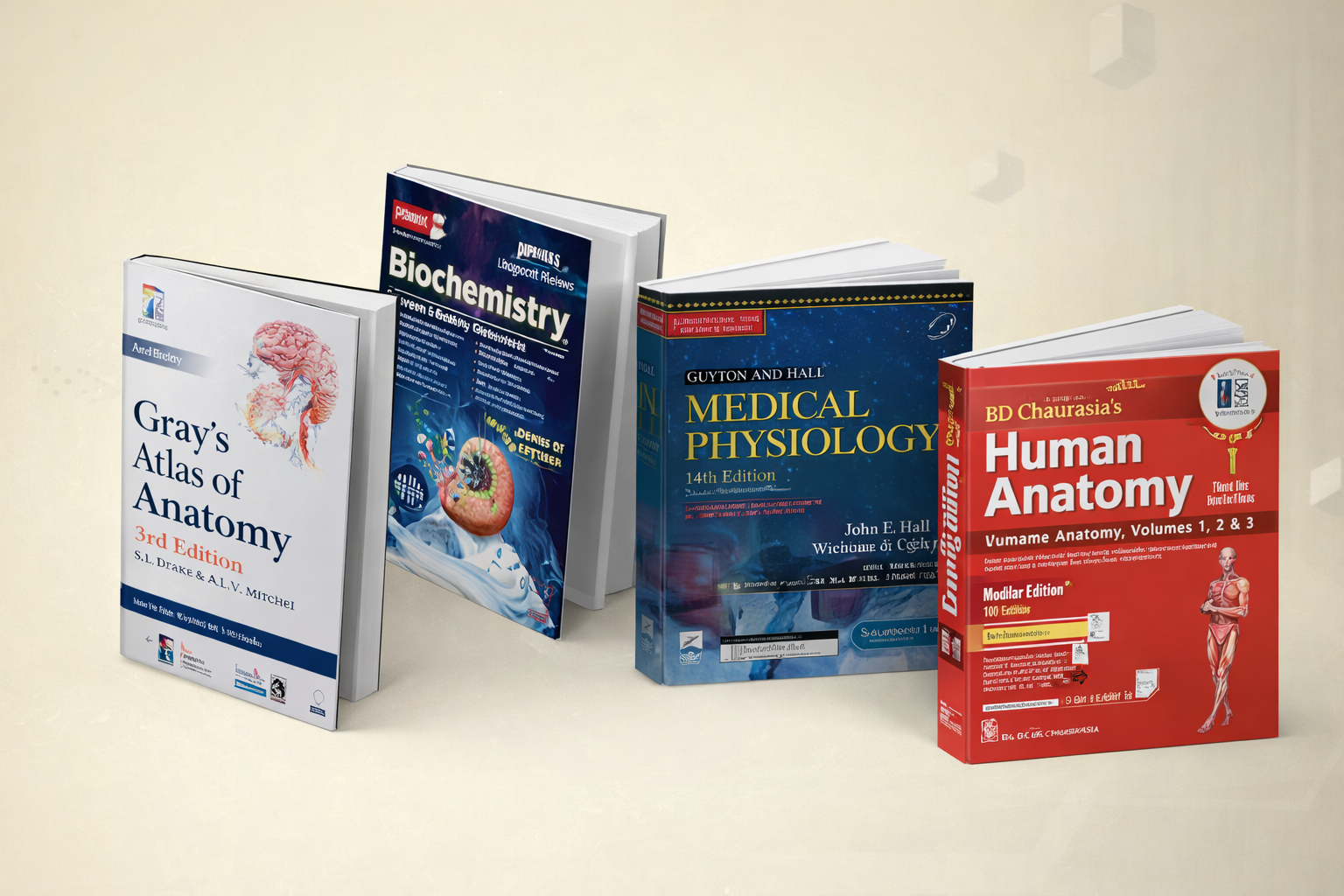
Anatomy Books Recommended by MBBS Toppers (2026 Guide): Best Books for First-Year Medical Students
Anatomy is one of the most demanding subjects in the first year of MBBS. It forms the foundation of clinical medicine by helping students understand the structure of the human body, relationships between organs, and the basis of surgical and diagnostic procedures. For many students, anatomy is also one of the largest subjects to master due to its vast syllabus and detailed practical requirements.
A common question among fresh MBBS students is:
“Which anatomy book do MBBS toppers actually recommend?”
The answer isn’t limited to a single textbook. High-performing students often use a combination of resources depending on their learning goals—whether it’s understanding concepts, preparing for university examinations, mastering dissections, or revising efficiently.
This guide compares the anatomy books most frequently recommended by successful MBBS students and faculty members. You’ll learn the strengths of each book, which type of learner it suits best, and how to build an effective anatomy study strategy for the Competency-Based Medical Education (CBME) curriculum.
Quick Answer
If you’re looking for the best anatomy books recommended by MBBS toppers, these are the most frequently suggested:
- BD Chaurasia’s Human Anatomy – Best for Indian MBBS university examinations.
- Vishram Singh Clinical Anatomy – Excellent for conceptual clarity and clinical correlations.
- Gray’s Anatomy for Students – Ideal for deep understanding and long-term reference.
- Netter’s Atlas of Human Anatomy – Outstanding for visual learning and practical anatomy.
- Cunningham’s Manual of Practical Anatomy – Essential for dissection hall preparation.
Most toppers recommend combining one primary textbook with an atlas and a practical manual rather than relying on a single resource.
Why Anatomy Is the Foundation of MBBS
Anatomy provides the structural framework for every clinical subject you’ll study later, including surgery, orthopedics, radiology, obstetrics, and medicine.
A strong understanding of anatomy helps students:
- Interpret medical imaging.
- Perform physical examinations.
- Understand surgical procedures.
- Learn physiology more effectively.
- Build confidence during clinical postings.
Developing this foundation early benefits both university examinations and future clinical practice.
What Makes a Good Anatomy Book?
An effective anatomy textbook should offer:
- Clear explanations
- Accurate anatomical terminology
- High-quality illustrations
- Clinical correlations
- Easy-to-follow diagrams
- Practical anatomy guidance
- Alignment with the MBBS curriculum
- Revision-friendly summaries
Choosing a book that matches your learning style is just as important as selecting a well-known title.
Top Anatomy Books Recommended by MBBS Toppers
1. BD Chaurasia’s Human Anatomy
Best For
- First-year MBBS students
- University examinations
- Practical anatomy
- Indian medical curriculum
BD Chaurasia remains one of the most widely used anatomy textbooks in Indian medical colleges.
Why Toppers Recommend It
- Simple language
- Well-labeled diagrams
- Clinical relevance
- Examination-oriented content
- Comprehensive regional anatomy
It is especially helpful for students preparing for university theory and practical examinations.
2. Vishram Singh Clinical Anatomy
Best For
- Conceptual learning
- CBME curriculum
- Clinical understanding
Vishram Singh has become increasingly popular because it integrates anatomy with clinical medicine.
Key Features
- Clinical case discussions
- High-quality illustrations
- Embryology integration
- Radiological anatomy
- Easy-to-read presentation
Students who enjoy understanding “why” rather than memorizing often appreciate this approach.
3. Gray’s Anatomy for Students
Best For
- Deep conceptual understanding
- Long-term medical education
- Advanced learners
Gray’s Anatomy is recognized internationally for its detailed explanations and exceptional illustrations.
Advantages
- Comprehensive coverage
- Excellent artwork
- Strong clinical context
- Updated anatomical concepts
- Radiology integration
While more detailed than required for many university exams, it serves as an excellent reference throughout medical school.
4. Netter’s Atlas of Human Anatomy
Best For
- Visual learners
- Practical anatomy
- Revision
- Surgical orientation
Netter’s Atlas is famous for its detailed anatomical illustrations.
Why Students Love It
- Beautiful medical artwork
- Realistic anatomical views
- Excellent labeling
- Easy revision
- Helpful for dissection and imaging interpretation
Many toppers use Netter alongside a primary textbook rather than as a standalone resource.
5. Cunningham’s Manual of Practical Anatomy
Best For
- Dissection hall
- Practical examinations
- Surface anatomy
This manual guides students through cadaver dissection and practical anatomy exercises.
It includes:
- Step-by-step dissections
- Anatomical landmarks
- Practical observations
- Clinical notes
It remains a valuable companion during laboratory sessions.
Comparison of Popular Anatomy Books
| Feature | BD Chaurasia | Vishram Singh | Gray’s | Netter Atlas |
|---|---|---|---|---|
| Beginner Friendly | ⭐⭐⭐⭐⭐ | ⭐⭐⭐⭐⭐ | ⭐⭐⭐⭐☆ | ⭐⭐⭐⭐⭐ |
| University Exams | ⭐⭐⭐⭐⭐ | ⭐⭐⭐⭐☆ | ⭐⭐⭐⭐☆ | ⭐⭐⭐☆☆ |
| Clinical Correlation | ⭐⭐⭐⭐☆ | ⭐⭐⭐⭐⭐ | ⭐⭐⭐⭐⭐ | ⭐⭐⭐⭐☆ |
| Illustrations | ⭐⭐⭐⭐☆ | ⭐⭐⭐⭐☆ | ⭐⭐⭐⭐⭐ | ⭐⭐⭐⭐⭐ |
| Conceptual Learning | ⭐⭐⭐⭐☆ | ⭐⭐⭐⭐⭐ | ⭐⭐⭐⭐⭐ | ⭐⭐⭐⭐☆ |
| Practical Use | ⭐⭐⭐⭐⭐ | ⭐⭐⭐⭐☆ | ⭐⭐⭐⭐☆ | ⭐⭐⭐⭐⭐ |
Study Strategy Used by MBBS Toppers
Many top-performing students follow a layered approach.
Step 1
Study theory using BD Chaurasia or Vishram Singh.
Step 2
Refer to Netter’s Atlas for visual understanding.
Step 3
Practice dissections using Cunningham’s Manual.
Step 4
Revise diagrams regularly.
Step 5
Practice previous-year university questions and viva topics.
This combination supports both conceptual understanding and examination preparation.
Common Anatomy Topics You Should Master
Focus on:
- Upper limb
- Lower limb
- Thorax
- Abdomen
- Head and neck
- Neuroanatomy
- Embryology
- Histology
- Surface anatomy
Rather than memorizing isolated facts, understand how structures relate to function and clinical practice.
Mistakes First-Year MBBS Students Should Avoid
Common pitfalls include:
- Memorizing without understanding.
- Ignoring diagrams.
- Skipping dissection sessions.
- Neglecting embryology.
- Delaying revision.
- Studying from too many books simultaneously.
Consistency and active learning are more effective than collecting multiple resources.
Where to Buy MBBS Anatomy Books
Purchase anatomy books from trusted medical bookstores, official publishers, or reputable online medical book platforms.
Medical-focused stores such as Medioks provide:
- Latest anatomy textbooks
- MBBS first-year book sets
- Student editions
- Authentic publications
- Multiple publisher options
Before buying, verify:
- Latest edition
- ISBN
- Publisher authenticity
- Printing quality
- Compatibility with your university curriculum
Authentic editions provide accurate diagrams and updated content.
Frequently Asked Questions
Which anatomy book is best for MBBS beginners?
BD Chaurasia’s Human Anatomy is widely recommended because of its simple language, clear diagrams, and alignment with the Indian MBBS curriculum.
Is Gray’s Anatomy too difficult for first-year students?
Gray’s Anatomy is more detailed than many university textbooks, but it is an excellent reference for students seeking deeper conceptual understanding.
Should I buy Netter’s Atlas?
Yes. Netter’s Atlas is highly recommended as a supplementary resource because its illustrations make complex anatomical relationships easier to understand.
Is Vishram Singh better than BD Chaurasia?
Both are excellent. BD Chaurasia is generally preferred for examination preparation, while Vishram Singh is valued for its clinical orientation and conceptual explanations.
How many anatomy books do MBBS toppers usually use?
Many toppers use one primary textbook, one atlas, and one practical manual. This balanced approach supports theory, visualization, and laboratory learning without becoming overwhelming.
Expert Recommendation
For most first-year MBBS students:
Primary Textbook
BD Chaurasia’s Human Anatomy
Concept Reference
Vishram Singh Clinical Anatomy
Atlas
Netter’s Atlas of Human Anatomy
Practical Guide
Cunningham’s Manual of Practical Anatomy
This combination covers theory, clinical application, visualization, and practical skills effectively.
Final Thoughts
Choosing the right anatomy books can make the first year of MBBS more manageable and rewarding. While BD Chaurasia’s Human Anatomy remains the preferred choice for many Indian students because of its exam-oriented presentation and accessible language, Vishram Singh Clinical Anatomy provides outstanding conceptual clarity and clinical relevance. Gray’s Anatomy for Students serves as an excellent long-term reference, while Netter’s Atlas and Cunningham’s Manual strengthen visual learning and practical anatomy skills.
Remember that the most successful MBBS students are not those who own the most books—they are those who use a carefully selected set of resources consistently. By combining a reliable textbook, an anatomy atlas, regular dissection practice, and systematic revision, you’ll build a strong anatomical foundation that supports success throughout medical school and beyond.