Important Chapters in Langman Embryology: High-Yield Guide for MBBS Students
Embryology is one of the most fascinating yet conceptually demanding areas of first-year MBBS. Students must understand how the human body develops from fertilization to a complex arrangement of tissues, organs, and systems. The challenge is not simply remembering developmental events but understanding their sequence, timing, and clinical consequences.
Langman’s Medical Embryology is widely used for its concept-driven approach and strong clinical correlations. However, students often ask:
Which are the most important chapters in Langman Embryology?
Quick answer: High-priority areas generally include gametogenesis, fertilization, the first weeks of development, gastrulation, embryonic folding, placenta and fetal membranes, birth defects, pharyngeal apparatus, cardiovascular development, nervous system development, gastrointestinal development, urogenital development, and development of the face and palate.
The exact examination priority can vary between universities. Therefore, students should use their official curriculum, faculty guidance, and previous examination patterns alongside any high-yield chapter list.
Important Langman Embryology Chapters at a Glance
| Priority Area | Why It Matters |
|---|---|
| Gametogenesis and Fertilization | Foundation of human development |
| Early Embryonic Development | Explains implantation and germ-layer formation |
| Gastrulation | Establishes the basic body plan |
| Embryonic Folding | Connects the flat disc with body formation |
| Placenta and Fetal Membranes | High clinical and examination relevance |
| Birth Defects | Links development with clinical medicine |
| Cardiovascular System | Conceptually important organ-system development |
| Pharyngeal Apparatus | Frequently challenging and clinically relevant |
| Nervous System | Important for neural tube development and anomalies |
| Face and Palate | Strong clinical correlation |
| Gastrointestinal System | Requires understanding of rotation and derivatives |
| Urogenital System | Important but conceptually demanding |
A useful strategy is to master general embryology first and then move to systemic embryology.
1. Gametogenesis and Fertilization
This is the starting point for understanding human development.
Important concepts include:
- Spermatogenesis
- Oogenesis
- Meiotic division
- Ovulation
- Fertilization
- Formation of the zygote
- Chromosomal abnormalities
Why Is This Chapter Important?
Later developmental events become easier when students understand how gametes are formed and how fertilization restores the diploid chromosome number.
Pay special attention to the sequence of fertilization rather than memorizing isolated steps.
Study Tip: Create a comparison table for spermatogenesis and oogenesis.
2. First and Second Weeks of Development
Early embryonic development introduces several structures that appear repeatedly throughout embryology.
Important areas include:
- Cleavage
- Morula
- Blastocyst formation
- Implantation
- Trophoblast differentiation
- Bilaminar germ disc
- Amniotic cavity
- Yolk sac
- Extraembryonic mesoderm
Students often struggle because many changes occur within a short developmental period.
Best Approach
Create a day-wise developmental timeline.
For example:
Fertilization → Cleavage → Morula → Blastocyst → Implantation
Understanding the sequence is more effective than memorizing paragraphs.
3. Gastrulation and the Third Week of Development
Gastrulation is one of the most important concepts in embryology.
It establishes the three germ layers:
- Ectoderm
- Mesoderm
- Endoderm
These layers later contribute to different tissues and organs.
Important topics include:
- Primitive streak
- Formation of germ layers
- Notochord
- Body axes
- Early differentiation
Why Is Gastrulation High-Yield?
Because it provides the foundation for understanding organ development.
A useful question to ask is:
“Which germ layer gives rise to this structure?”
Derivative tables and active recall work particularly well here.
4. Embryonic Folding
Embryonic folding explains how the relatively flat embryonic disc develops into a three-dimensional body form.
Focus on:
- Cephalocaudal folding
- Lateral folding
- Formation of the gut tube
- Changes in body shape
- Relationship with the umbilical region
This chapter is easier when studied visually.
Study Tip: Draw simplified before-and-after diagrams instead of relying only on text.
5. Placenta and Fetal Membranes
This is an important area because it combines anatomy, physiology, and clinical relevance.
Key topics include:
- Chorion
- Amnion
- Placental development
- Placental circulation
- Umbilical cord
- Amniotic fluid
- Multiple pregnancies
- Placental abnormalities
Clinical correlations make this chapter especially relevant.
Students should understand both normal development and what happens when development is abnormal.
6. Birth Defects and Prenatal Diagnosis
One of Langman’s major strengths is its integration of developmental abnormalities with normal embryology.
Important concepts include:
- Congenital anomalies
- Teratogens
- Critical periods of development
- Genetic and environmental influences
- Principles of prenatal diagnosis
Do not study congenital abnormalities as disconnected lists.
Connect each anomaly with the developmental process that failed.
Use this formula:
Normal Development → Developmental Error → Resulting Anomaly
7. Pharyngeal Apparatus
The pharyngeal apparatus is frequently considered one of the more difficult embryology topics.
Students should understand:
- Pharyngeal arches
- Pouches
- Clefts
- Membranes
- Major derivatives
Best Way to Study
Use separate tables for:
- Arch derivatives
- Nerve supply
- Muscular derivatives
- Skeletal derivatives
- Arterial derivatives
Repeated active recall is more effective than rereading the same table.
8. Cardiovascular System Development
The cardiovascular system is one of the most important areas of systemic embryology.
Key concepts include:
- Heart tube formation
- Cardiac looping
- Septation
- Development of great vessels
- Fetal circulation
- Changes after birth
- Congenital heart defects
This topic can initially feel complex because several structures change simultaneously.
Study Strategy
Learn the normal developmental sequence first. Only then study congenital abnormalities.
For example:
Normal septation → Identify the developmental defect → Understand the resulting condition
9. Nervous System Development
Important topics include:
- Neural tube formation
- Neural crest cells
- Development of the brain
- Development of the spinal cord
- Neural tube defects
Neural crest derivatives deserve special attention because they contribute to multiple structures throughout the body.
Create a dedicated neural crest derivative chart and revise it repeatedly.
10. Development of the Face and Palate
This chapter has strong clinical relevance.
Important concepts include:
- Facial prominences
- Fusion of facial structures
- Development of the nose
- Formation of the palate
- Cleft lip
- Cleft palate
Use sequential diagrams to understand which structures approach and fuse.
This is far more effective than memorizing descriptions without visualization.
11. Gastrointestinal System Development
Important areas include:
- Foregut
- Midgut
- Hindgut
- Gut derivatives
- Physiological herniation
- Midgut rotation
- Congenital abnormalities
The most effective approach is to create a comparison table showing:
Embryological Division → Adult Derivatives → Blood Supply
For intestinal rotation, use diagrams and follow the sequence step by step.
12. Urogenital System Development
The urogenital system is another conceptually demanding area.
Important topics include:
- Kidney development
- Development of the urinary system
- Gonadal development
- Genital ducts
- External genitalia
- Congenital anomalies
Students often struggle because male and female developmental pathways must be compared.
Use a side-by-side comparison chart to simplify the topic.
Which Langman Chapters Should You Study First?
A practical study sequence is:
Early Development → Gastrulation → Folding → Placenta → Birth Defects → Pharyngeal Apparatus → Cardiovascular System → Nervous System → Face and Palate → Gastrointestinal System → Urogenital System
This sequence moves from foundational concepts to system-specific development.
However, your university teaching schedule should remain the primary guide.
How to Study Langman Embryology Effectively
Do not read Langman like a novel.
For each chapter:
- Read the chapter overview.
- Identify the developmental timeline.
- Study the diagrams carefully.
- Create a one-page flowchart.
- Connect normal development with congenital anomalies.
- Practise drawing simplified diagrams.
- Recall the sequence without looking at the book.
The most useful question in embryology is:
“What happens next, and why?”
If you can explain the sequence without looking at the textbook, your understanding is improving.
Where to Buy Langman’s Medical Embryology Online
Before purchasing Langman’s Medical Embryology, check:
- Correct book title
- Author and publisher details
- Latest available edition
- Format
- Seller authenticity
- Edition recommended by your institution
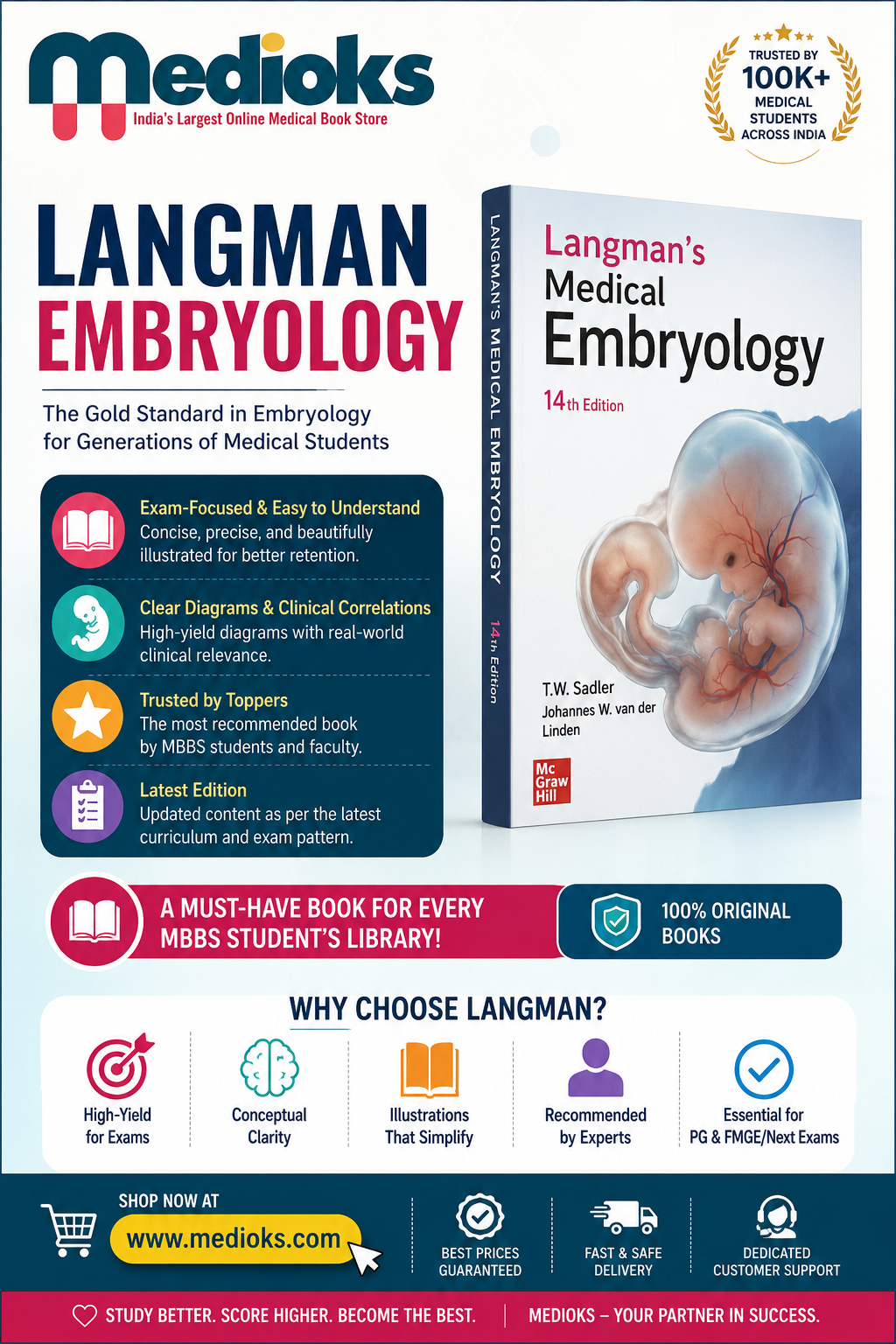
Students searching for Langman Embryology, MBBS first-year books, and other medical textbooks can explore relevant titles through Medioks.
Always verify the exact edition before purchasing.
Frequently Asked Questions
Which are the most important chapters in Langman Embryology?
Early embryonic development, gastrulation, embryonic folding, placenta, birth defects, pharyngeal apparatus, cardiovascular development, nervous system development, face and palate, gastrointestinal development, and urogenital development are commonly high-priority areas.
Is Langman good for MBBS students?
Yes. Langman’s Medical Embryology is widely valued for conceptual explanations, developmental sequences, diagrams, and clinical correlations.
Which is the most difficult topic in embryology?
Difficulty varies by student, but cardiovascular development, pharyngeal apparatus, intestinal rotation, and urogenital development are commonly considered challenging.
How can I study Langman quickly?
Focus on developmental sequences, diagrams, timelines, derivative tables, and clinical correlations. Use active recall rather than repeated passive reading.
Is reading only important chapters enough?
No. High-yield chapters can help prioritize revision, but students should follow their complete university curriculum and faculty guidance.
Final Thoughts
The important chapters in Langman Embryology are those that build a strong understanding of both general and systemic development.
Begin with fertilization, early development, gastrulation, folding, and placenta. Then move to major systemic topics such as the pharyngeal apparatus, cardiovascular system, nervous system, face and palate, gastrointestinal system, and urogenital system.
The most effective way to study embryology is to think in sequences:
Origin → Developmental Change → Adult Structure → Clinical Abnormality
Once you understand that pattern, Langman becomes more than a textbook to memorize. It becomes a framework for understanding how the human body develops—and why developmental abnormalities occur.