Langman Embryology vs Inderbir Singh: Which Book Is Better for MBBS Students?
Embryology is one of the most conceptually challenging areas of first-year MBBS. Students must understand how a single fertilized cell develops into complex organs and body systems while also remembering developmental timelines, embryological derivatives, folding, congenital anomalies, and clinical correlations.
Two books frequently considered by Indian medical students are Langman’s Medical Embryology and Human Embryology by Inderbir Singh.
So, Langman Embryology vs Inderbir Singh—which is better?
Quick answer: Choose Langman’s Medical Embryology if you prefer strong conceptual explanations, developmental mechanisms, and clinical correlations. Choose Inderbir Singh’s Human Embryology if you want a more concise, undergraduate-friendly resource that can be easier to revise for MBBS university examinations.
For many students, the best choice depends on learning style rather than one book being universally superior.
Langman Embryology vs Inderbir Singh: Quick Comparison
| Feature | Langman’s Medical Embryology | Inderbir Singh’s Human Embryology |
|---|---|---|
| Best For | Conceptual understanding | Concise undergraduate study |
| Writing Style | Detailed and explanatory | Direct and exam-friendly |
| Clinical Correlation | Strong | Relevant to undergraduate needs |
| Revision | Requires selective reading | Generally easier for quick revision |
| Global Reference Value | High | Popular among Indian MBBS students |
| Beginner Friendliness | Moderate | Generally high |
| Ideal Use | Concepts and clinical integration | University exams and revision |
What Is Langman’s Medical Embryology?
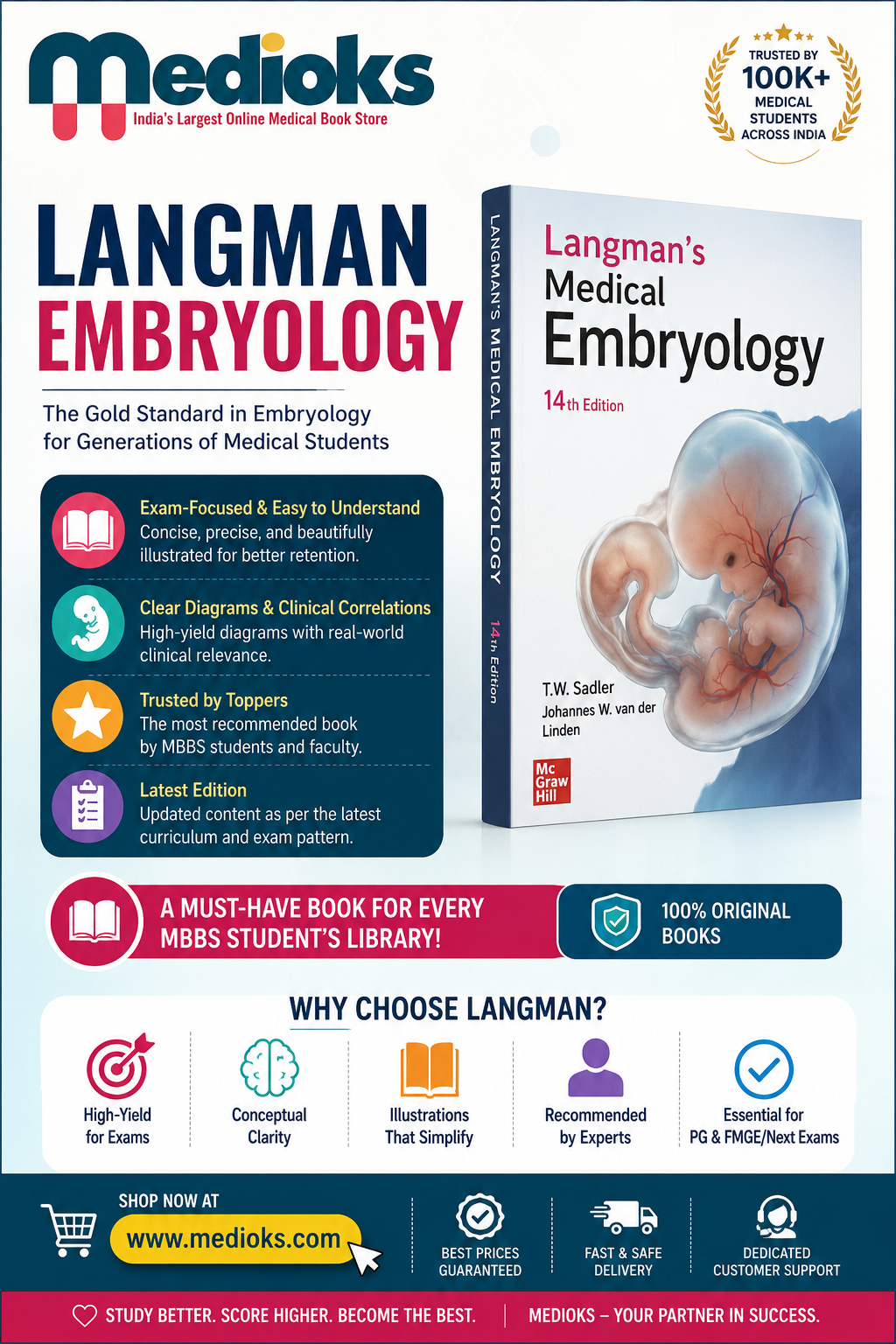
Langman’s Medical Embryology is a widely recognized embryology textbook used by medical students internationally. It explains normal human development while connecting embryological processes with congenital abnormalities and clinical medicine.
The book commonly covers:
- Gametogenesis
- Fertilization
- Early embryonic development
- Gastrulation
- Embryonic folding
- Placenta and fetal membranes
- Development of organ systems
- Congenital abnormalities
- Clinical correlations
Its major strength is explaining how and why development occurs, rather than presenting embryology only as facts to memorize.
What Is Inderbir Singh’s Human Embryology?
Human Embryology by Inderbir Singh is a familiar resource among Indian undergraduate medical students. Its presentation is generally oriented toward helping students understand essential embryological concepts without excessive specialist-level detail.
It is often valued for:
- Concise explanations
- Structured presentation
- Undergraduate relevance
- Revision-friendly content
- Alignment with common MBBS learning needs
For students managing Anatomy, Physiology, and Biochemistry simultaneously, a concise embryology resource can make syllabus completion more manageable.
1. Which Book Is Better for Conceptual Understanding?
Langman generally has the advantage.
Embryology involves dynamic processes. Reading only a sequence of events can make the subject difficult to visualize.
Langman places greater emphasis on:
- Developmental mechanisms
- Relationships between structures
- Developmental timelines
- Congenital anomalies
- Clinical significance
This can help students answer an important question:
“What happens if normal development is disrupted?”
Verdict
Choose Langman if deep conceptual understanding is your priority.
2. Which Book Is Easier for Beginners?
Many Indian MBBS students may find Inderbir Singh easier to begin with, particularly when they need a straightforward introduction aligned with undergraduate learning.
Langman can sometimes feel more detailed to a student encountering embryology for the first time.
However, difficulty also depends on your learning style. Students who enjoy explanatory, mechanism-based learning may actually find Langman easier.
Verdict
Inderbir Singh is generally more concise; Langman is more explanatory.
3. Which Book Is Better for MBBS University Exams?
For university examination preparation, Inderbir Singh can be more convenient for quick revision because of its concise presentation.
MBBS examinations commonly require students to explain topics such as:
- Fertilization
- Implantation
- Placenta
- Neural tube development
- Pharyngeal arches
- Development of the heart
- Development of the face
- Gut development
- Congenital anomalies
A concise book can make repeated revision easier.
However, examination performance depends on your university syllabus, faculty guidance, diagrams, and answer-writing practice—not simply the textbook chosen.
Verdict
For rapid university exam preparation, Inderbir Singh may be more practical. For stronger understanding behind exam answers, Langman can be highly valuable.
4. Which Book Has Better Clinical Correlations?
Langman is particularly strong in clinical correlation.
Embryology becomes more meaningful when developmental processes are connected with congenital conditions.
Examples include:
- Neural tube defects
- Cleft lip and palate
- Congenital heart defects
- Abnormal gut rotation
- Developmental abnormalities of the urinary system
Clinical correlations help students understand why embryology remains relevant beyond the first year of MBBS.
Verdict
Choose Langman for stronger clinical integration.
5. Which Book Is Better for Diagrams and Visualization?
Embryology is difficult to learn without visualizing developmental changes.
The ideal resource should help you understand:
- Movement of structures
- Folding
- Rotation
- Fusion
- Migration
- Changes over time
Both books support visual learning, but students should evaluate the specific edition available to them because illustration styles and presentation can change between editions.
Regardless of the book, practice drawing simplified exam-oriented diagrams yourself.
6. Which Book Is Better for Quick Revision?
Inderbir Singh generally has the advantage for concise revision.
Before university examinations, students often need to revise multiple Anatomy topics within a short period. A shorter presentation can make repeated reading more practical.
Langman may require selective revision because of its greater explanatory depth.
Verdict
Choose Inderbir Singh for faster revision and Langman when you need to revisit concepts in greater depth.
Langman vs Inderbir Singh: Which One Should You Buy?
Choose Langman’s Medical Embryology if you:
- Prefer conceptual learning.
- Want strong clinical correlations.
- Enjoy detailed explanations.
- Want a globally recognized reference.
- Have a strong interest in developmental medicine.
Choose Inderbir Singh’s Human Embryology if you:
- Prefer concise explanations.
- Want an undergraduate-focused book.
- Need faster revision.
- Are primarily preparing for university examinations.
- Prefer a straightforward approach.
Can You Use Both Books?
Yes, but you do not need to read both from cover to cover.
A practical strategy is:
Primary Book + Selective Reference
For example:
- Use Inderbir Singh as your main exam-oriented book.
- Consult Langman when a developmental mechanism is difficult to understand.
Alternatively:
- Use Langman as your primary conceptual resource.
- Use concise notes for final examination revision.
This approach prevents resource overload.
How to Study Embryology Effectively
Regardless of the textbook, use a developmental sequence.
For every topic, ask:
- What is the original structure?
- When does development begin?
- What changes occur?
- Where does the structure move?
- What does it become?
- What happens if development goes wrong?
Create:
- Timelines
- Flowcharts
- Derivative tables
- Simplified diagrams
- Congenital anomaly summaries
Do not memorize isolated facts without understanding the sequence.
Common Mistakes Students Make
Avoid:
- Reading too many textbooks simultaneously.
- Memorizing without visualizing development.
- Ignoring diagrams.
- Leaving embryology until the examination period.
- Studying congenital anomalies separately from normal development.
- Failing to revise developmental sequences.
Embryology becomes easier when studied as a continuous process rather than a collection of disconnected facts.
Where to Buy Embryology Books Online
When purchasing medical textbooks, check:
- Exact author and title
- Latest available edition
- Publisher details
- Book format
- Seller authenticity
Students searching for Langman’s Medical Embryology, Inderbir Singh Human Embryology, and other MBBS first-year books can explore relevant medical textbooks through Medioks.
Always confirm the edition recommended by your faculty or institution before purchasing.
Frequently Asked Questions
Is Langman better than Inderbir Singh?
Langman is generally stronger for conceptual depth and clinical correlation, while Inderbir Singh can be more convenient for concise undergraduate study and revision.
Which embryology book is best for first-year MBBS?
The best book depends on your learning style. Choose Langman for detailed conceptual learning and Inderbir Singh for a more concise approach.
Is Langman enough for MBBS embryology?
It provides strong conceptual coverage, but students should also follow their university syllabus, faculty guidance, and practical requirements.
Can I read both Langman and Inderbir Singh?
Yes. However, using one as the primary textbook and the other selectively is usually more efficient.
Which book is better for exam revision?
Inderbir Singh is often easier for rapid revision because of its relatively concise presentation.
Final Verdict: Langman Embryology or Inderbir Singh?
The Langman Embryology vs Inderbir Singh comparison is ultimately about depth versus conciseness.
Langman’s Medical Embryology is an excellent choice for students who want deeper conceptual understanding and stronger clinical correlation. Inderbir Singh’s Human Embryology is well suited to students who prefer concise explanations and an undergraduate-oriented approach for regular study and exam revision.
For many MBBS students, the most effective strategy is not to collect multiple books but to choose one primary resource and study it consistently.
Understand developmental sequences, draw diagrams, connect congenital anomalies with normal development, and revise repeatedly. That approach will contribute far more to your performance than constantly switching between textbooks.