How to Choose the Right MBBS Books for Every Semester (2026 Complete Guide)
One of the biggest challenges every MBBS student faces is deciding which books to buy for each semester. Walk into any medical bookstore or browse online, and you’ll find dozens of textbooks, review books, practical manuals, and question banks for every subject. While having multiple resources may seem helpful, it often leads to confusion, unnecessary expenses, and information overload.
The key to academic success is choosing the right MBBS books—not the maximum number of books. A carefully selected textbook for each subject, supported by practical manuals and revision resources, is usually enough to build strong concepts, perform well in university examinations, and prepare for competitive exams like NEXT.
This guide explains how to choose the right MBBS books for every semester, highlights the best study resources for each phase of the MBBS curriculum, and shares practical tips to help you invest wisely.
Quick Answer: How to Choose MBBS Books
If you’re unsure where to start, follow these principles:
- Buy one standard textbook for each subject.
- Choose the latest edition aligned with the NMC Competency-Based Medical Education (CBME) curriculum.
- Prefer books recommended by your professors and senior students.
- Use practical manuals for laboratory and clinical postings.
- Add question banks only after completing your core textbook.
- Avoid buying multiple books covering the same syllabus.
This approach saves money, reduces confusion, and improves long-term understanding.
Why Choosing the Right MBBS Books Matters
Medical textbooks are not just examination resources—they shape your understanding of medicine throughout your career.
The right books help you:
- Build strong conceptual foundations.
- Understand clinical applications.
- Develop diagnostic reasoning.
- Prepare for university examinations.
- Build a base for NEXT, NEET PG, and INI-CET.
- Reduce unnecessary study stress.
Remember, mastering one high-quality textbook is more effective than reading several superficially.
Understand the MBBS Curriculum Before Buying Books
The NMC Competency-Based Medical Education (CBME) curriculum emphasizes integrated learning, clinical relevance, early patient exposure, and competency-based assessment.
Before purchasing books, review:
- Your university syllabus.
- Semester-wise subject list.
- Practical requirements.
- Internal assessment pattern.
- Faculty recommendations.
Understanding the curriculum helps you buy only the resources you actually need.
Choosing Books for First-Year MBBS
The first year focuses on the basic sciences that form the foundation of clinical medicine.
Anatomy
Choose books that provide:
- Clear diagrams.
- Clinical correlations.
- Region-wise organization.
- Easy-to-understand language.
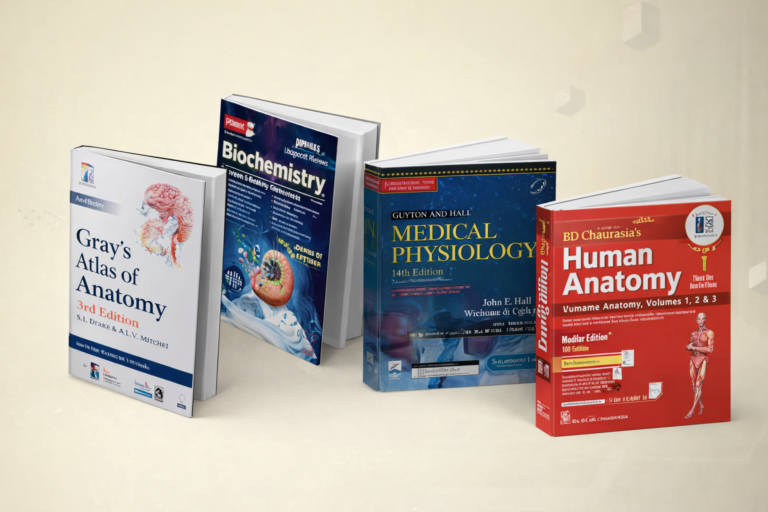
Many students pair a standard anatomy textbook with a high-quality anatomical atlas for visual learning and dissection.
Additional Resources
- Dissection manuals
- Anatomy atlases
- Histology atlases
Physiology
A good physiology textbook should explain:
- Body systems logically.
- Normal physiological mechanisms.
- Clinical relevance.
- Flowcharts and diagrams.
Conceptual understanding is more important than memorization in this subject.
Biochemistry
When selecting a biochemistry book, look for:
- Clinical applications.
- Simplified metabolic pathways.
- Medical correlations.
- Self-assessment questions.
Avoid books that focus only on biochemical reactions without explaining their clinical significance.
Choosing Books for Second-Year MBBS
Second year introduces disease processes, microorganisms, drugs, and medico-legal concepts.
Pathology
Choose a textbook that balances:
- Disease mechanisms.
- Histopathology.
- Clinical examples.
- Easy illustrations.
Some students prefer concept-heavy references, while others choose concise exam-oriented texts. Select the one that matches your learning style.
Microbiology
An effective microbiology textbook should include:
- Bacteriology
- Virology
- Immunology
- Mycology
- Parasitology
- Infection control
- Antimicrobial resistance
- Practical laboratory diagnosis
Look for updated content aligned with current infectious disease guidelines.
Pharmacology
A good pharmacology book should explain:
- Drug classification.
- Mechanism of action.
- Clinical indications.
- Adverse effects.
- Drug interactions.
- Rational prescribing.
Tables, mnemonics, and flowcharts make revision easier.
Forensic Medicine
Choose resources that emphasize:
- Medico-legal procedures.
- Toxicology.
- Legal responsibilities of doctors.
- Clinical case discussions.
Practical viva questions are particularly helpful in this subject.
Choosing Books for Third-Year MBBS
Clinical exposure increases significantly during this stage.
Community Medicine
Select books that cover:
- Epidemiology.
- National health programmes.
- Biostatistics.
- Preventive medicine.
- Public health management.
Current government health initiatives and vaccination guidelines should be included.
ENT
Look for books with:
- Clinical photographs.
- Diagnostic flowcharts.
- Examination techniques.
- Surgical basics.
- Practical viva preparation.
Ophthalmology
Good ophthalmology textbooks provide:
- High-quality illustrations.
- Clinical images.
- Common eye diseases.
- Diagnostic procedures.
- Case-based discussions.
Visual learning is especially important in this subject.
Choosing Books for Final-Year MBBS
The final year requires resources that connect theory with patient care.
Medicine
Choose books that explain:
- Clinical examination.
- Differential diagnosis.
- Disease management.
- Evidence-based treatment.
- Clinical reasoning.
Clinical case discussions improve understanding significantly.
Surgery
Your surgery book should include:
- Operative principles.
- Surgical anatomy.
- Trauma management.
- Preoperative assessment.
- Postoperative care.
Flowcharts and clinical algorithms are valuable during revision.
Obstetrics & Gynaecology
Look for books covering:
- Pregnancy management.
- Labor.
- Obstetric emergencies.
- Gynecological disorders.
- Family planning.
Clinical photographs and management algorithms are particularly useful.
Pediatrics
A comprehensive pediatric textbook should include:
- Growth and development.
- Neonatology.
- Childhood infections.
- Nutrition.
- Pediatric emergencies.
Clinical case discussions enhance practical understanding.
Standard Textbooks vs Review Books
Many students wonder whether they should purchase review books immediately.
Standard Textbooks
Best for:
- Concept building.
- Clinical understanding.
- Long-term retention.
- NEXT preparation.
Review Books
Useful for:
- Rapid revision.
- University examinations.
- MCQ practice.
- Last-minute preparation.
Start with standard textbooks and use review books only after mastering the basics.
Practical Manuals and Logbooks
Practical learning is an essential part of MBBS.
Do not overlook:
- Laboratory manuals.
- Clinical logbooks.
- Practical record books.
- OSCE/OSPE guides.
- Clinical examination handbooks.
These resources help during practical examinations and clinical postings.
Printed Books vs Digital Resources
Both formats have advantages.
Printed Books
- Better for long study sessions.
- Easier annotation.
- Reduced screen fatigue.
- Improved retention for many learners.
Digital Resources
- Convenient portability.
- Search functionality.
- Quick updates.
- Easy access across devices.
Many successful students use printed textbooks for detailed study and digital resources for quick revision.
Common Mistakes to Avoid
Many MBBS students make avoidable purchasing mistakes.
Avoid:
- Buying every recommended book.
- Purchasing outdated editions.
- Ignoring faculty recommendations.
- Choosing books only because friends use them.
- Prioritizing summaries over standard textbooks.
- Skipping practical manuals.
Your learning style and curriculum should guide your choices.
Tips to Save Money on MBBS Books
Medical textbooks are a long-term investment, but you can reduce costs by:
- Purchasing books semester-wise instead of all at once.
- Comparing prices across trusted bookstores.
- Buying the latest editions only for core subjects.
- Using your college library for expensive reference books.
- Looking for student discounts or bundled offers.
Frequently Asked Questions (FAQs)
How many books should I buy for each MBBS subject?
In most cases, one standard textbook, one practical manual, and an optional question bank are sufficient.
Should I buy all MBBS books in the first year?
No. Purchase books according to your current semester and curriculum. Buying everything at once often leads to unnecessary expenses.
Are review books enough for MBBS?
Review books are useful for revision but should not replace standard textbooks for conceptual learning.
Should I buy the latest edition?
Yes. Updated editions include revised classifications, current treatment guidelines, and competency-based content aligned with the NMC CBME curriculum.
Are digital books better than printed books?
Both have advantages. Printed books are generally preferred for detailed study, while digital resources are convenient for quick revision and portability.
Conclusion
Choosing the right MBBS books is about quality, not quantity. The best study strategy is to invest in one trusted textbook per subject, use practical manuals during laboratory and clinical training, and supplement your preparation with review resources only when necessary.
By selecting books that match your university syllabus, learning style, and the latest NMC CBME curriculum, you can build strong concepts, perform confidently in examinations, and prepare effectively for future competitive exams such as NEXT and NEET PG. Remember, the most successful medical students are not those who own the most books—they are the ones who thoroughly understand the books they choose.