Clinical Skills Every MBBS Student Learns from Hutchison
The transition from preclinical subjects to hospital postings is one of the most important stages of MBBS. Medical students move from learning diseases in textbooks to interacting with real patients, taking histories, identifying clinical signs, and developing diagnostic reasoning.
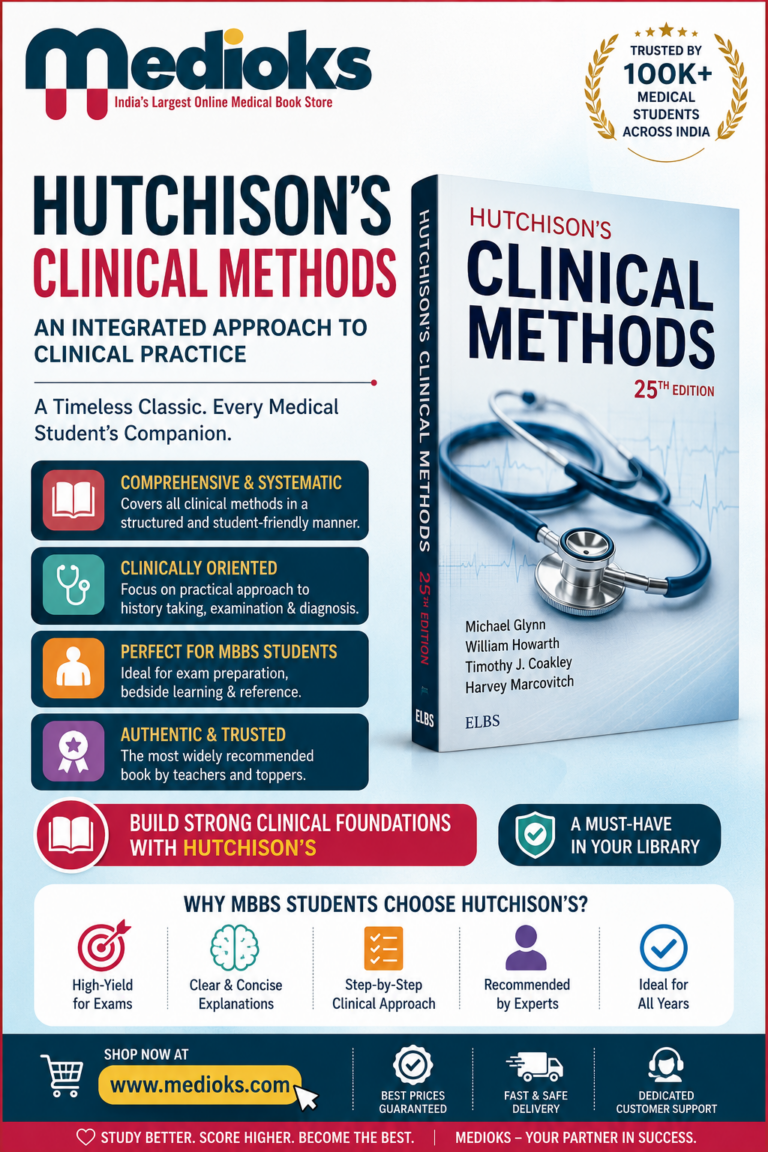
This is where Hutchison’s Clinical Methods becomes a valuable learning resource.
Rather than treating clinical examination as a checklist of procedures, the book helps students understand a broader principle: good clinical medicine begins with careful observation, structured questioning, systematic examination, and thoughtful interpretation.
So, what clinical skills can MBBS students learn from Hutchison?
Quick answer: Hutchison’s Clinical Methods helps students develop essential skills in patient communication, history taking, general physical examination, systemic examination, recognition of clinical signs, clinical reasoning, differential diagnosis, case presentation, and patient-centred assessment.
However, no textbook can replace supervised bedside practice. The strongest learning model is:
Read → Observe → Practise → Receive Feedback → Reflect → Repeat
Essential Clinical Skills Learned from Hutchison at a Glance
| Clinical Skill | Why It Matters |
|---|---|
| Patient Communication | Builds trust and improves information gathering |
| History Taking | Provides the foundation for diagnosis |
| General Examination | Identifies important systemic clues |
| Systemic Examination | Enables structured assessment |
| Recognition of Clinical Signs | Connects physical findings with disease |
| Clinical Reasoning | Helps develop differential diagnoses |
| Case Presentation | Improves communication with the medical team |
| Patient-Centred Approach | Keeps the individual, not only the disease, at the centre of care |
1. How to Communicate with a Patient
One of the first clinical skills every MBBS student must develop is effective patient communication.
A good consultation requires more than asking a list of questions. Students need to learn how to:
- Introduce themselves appropriately
- Explain their role
- Seek consent
- Maintain privacy
- Listen without unnecessary interruption
- Ask clear questions
- Respond professionally to sensitive information
- Show respect for patient concerns
Good communication is not separate from diagnosis. The quality of the conversation directly affects the quality of the information obtained.
A patient who feels heard is often better able to explain symptoms, concerns, and relevant history.
2. Structured History Taking
History taking is one of the most important skills in clinical medicine.
A systematic history commonly explores:
- Presenting complaints
- History of the presenting illness
- Past medical and surgical history
- Medication history
- Allergy history
- Family history
- Personal and social history
- Relevant occupational and lifestyle factors
- System-specific symptoms
The key skill is not merely memorizing headings.
Students must learn why each question matters.
For example, the same symptom may have different significance depending on:
- Onset
- Duration
- Progression
- Associated symptoms
- Risk factors
- Previous episodes
A well-taken history begins the process of clinical reasoning before the physical examination starts.
3. Symptom Analysis
Hutchison helps students approach symptoms systematically.
Consider pain. Instead of simply recording that a patient has pain, a medical student should explore:
- Site
- Onset
- Character
- Radiation
- Associated symptoms
- Timing
- Aggravating factors
- Relieving factors
- Severity
The exact framework may vary, but the principle remains the same: a symptom must be characterized before it can be interpreted.
This skill applies to symptoms such as:
- Chest pain
- Breathlessness
- Abdominal pain
- Headache
- Cough
- Fever
- Weakness
Structured symptom analysis helps narrow the differential diagnosis.
4. General Physical Examination
Before examining an individual organ system, students learn to observe the patient as a whole.
General examination may include assessment of:
- Overall appearance
- Level of consciousness
- Hydration
- Nutritional status
- Pallor
- Jaundice
- Cyanosis
- Clubbing
- Lymph nodes
- Oedema
- Vital signs
One of the most valuable lessons is that observation begins before touching the patient.
How is the patient sitting? Are they breathless? Do they appear uncomfortable? Is there an obvious abnormality?
Experienced clinical assessment often begins with careful observation.
5. Systematic Physical Examination
Clinical examination requires a reproducible sequence.
Students learn the core principles of:
- Inspection
- Palpation
- Percussion
- Auscultation
These methods are then applied to different systems.
Cardiovascular Examination
Students learn to assess features such as the pulse, blood pressure, precordium, heart sounds, and relevant peripheral signs.
Respiratory Examination
The approach includes observation, chest expansion, percussion, breath sounds, and additional findings where relevant.
Abdominal Examination
Students develop a systematic approach to inspection, palpation, percussion, and auscultation.
Neurological Examination
This involves structured assessment of higher functions, cranial nerves, motor function, sensory function, reflexes, and coordination.
The objective is not simply to memorize the sequence. Students should understand what each step is looking for.
6. Recognizing and Interpreting Clinical Signs
Finding a clinical sign is only half the task.
The next question is:
What does this finding mean?
For example, identifying clubbing should lead to further questions:
- Is it truly present?
- What conditions can cause it?
- What other findings should be sought?
- Does it fit the patient’s history?
This transition from observation to interpretation is central to clinical medicine.
Students should avoid treating physical signs as isolated facts. Every finding must be interpreted within the patient’s complete clinical context.
7. Developing Clinical Reasoning
Clinical reasoning is the process of connecting information from:
History + Examination + Disease Knowledge + Clinical Context
A student may begin with a symptom and gradually build a list of possible explanations.
For example:
Breathlessness → History → Examination Findings → Differential Diagnoses → Appropriate Investigations
Hutchison encourages students to understand why information is being collected rather than performing examinations mechanically.
Good clinical reasoning requires students to ask:
- What are the possible diagnoses?
- Which diagnosis is most likely?
- Which findings support it?
- Which findings argue against it?
- What important condition must not be missed?
This skill develops gradually through repeated patient encounters.
8. Building a Differential Diagnosis
A differential diagnosis is not simply a long list of diseases.
A useful differential should be:
- Clinically relevant
- Prioritized
- Supported by evidence
- Adapted as new information appears
Students learn to combine symptoms and signs to create diagnostic possibilities.
A practical approach is to classify possibilities according to:
- Common conditions
- Serious conditions
- Treatable conditions
- Diagnoses strongly supported by the findings
This prevents random disease listing and encourages structured thinking.
9. Presenting a Clinical Case
Case presentation is an essential skill for ward rounds, practical examinations, and professional communication.
A good presentation should be:
- Structured
- Concise
- Accurate
- Clinically relevant
Students should learn to distinguish between important information and unnecessary detail.
A typical presentation may summarize:
- Patient profile
- Presenting complaint
- Relevant history
- Important examination findings
- Clinical impression
- Differential diagnosis
The goal is to communicate enough information for another clinician to understand the case clearly.
10. Understanding the Limits of Clinical Examination
An important part of clinical maturity is recognizing that history and examination do not answer every question.
Clinical findings may need to be supported by:
- Laboratory investigations
- Imaging
- Physiological tests
- Specialist assessment
The purpose of investigations is not to replace clinical reasoning but to answer focused clinical questions.
A strong student learns to ask:
“What am I trying to confirm, exclude, or understand with this investigation?”
11. Developing a Patient-Centred Approach
Perhaps one of the most important lessons in clinical medicine is that a patient is more than a diagnosis.
Illness can affect:
- Daily activities
- Family life
- Employment
- Emotional well-being
- Independence
- Quality of life
Clinical assessment should therefore consider the patient’s concerns, expectations, circumstances, and priorities.
This broader perspective helps transform examination skills into meaningful patient care.
How to Study Hutchison’s Clinical Methods Effectively
Do not read a clinical methods textbook only before examinations.
Use this practical method:
- Read the relevant examination chapter before your clinical posting.
- Observe the technique being demonstrated.
- Practise under appropriate supervision.
- Ask for feedback on technique and communication.
- Write or present your findings clearly.
- Review the clinical significance of abnormal signs.
The most important principle is:
Clinical skills are learned through deliberate practice, not passive reading.
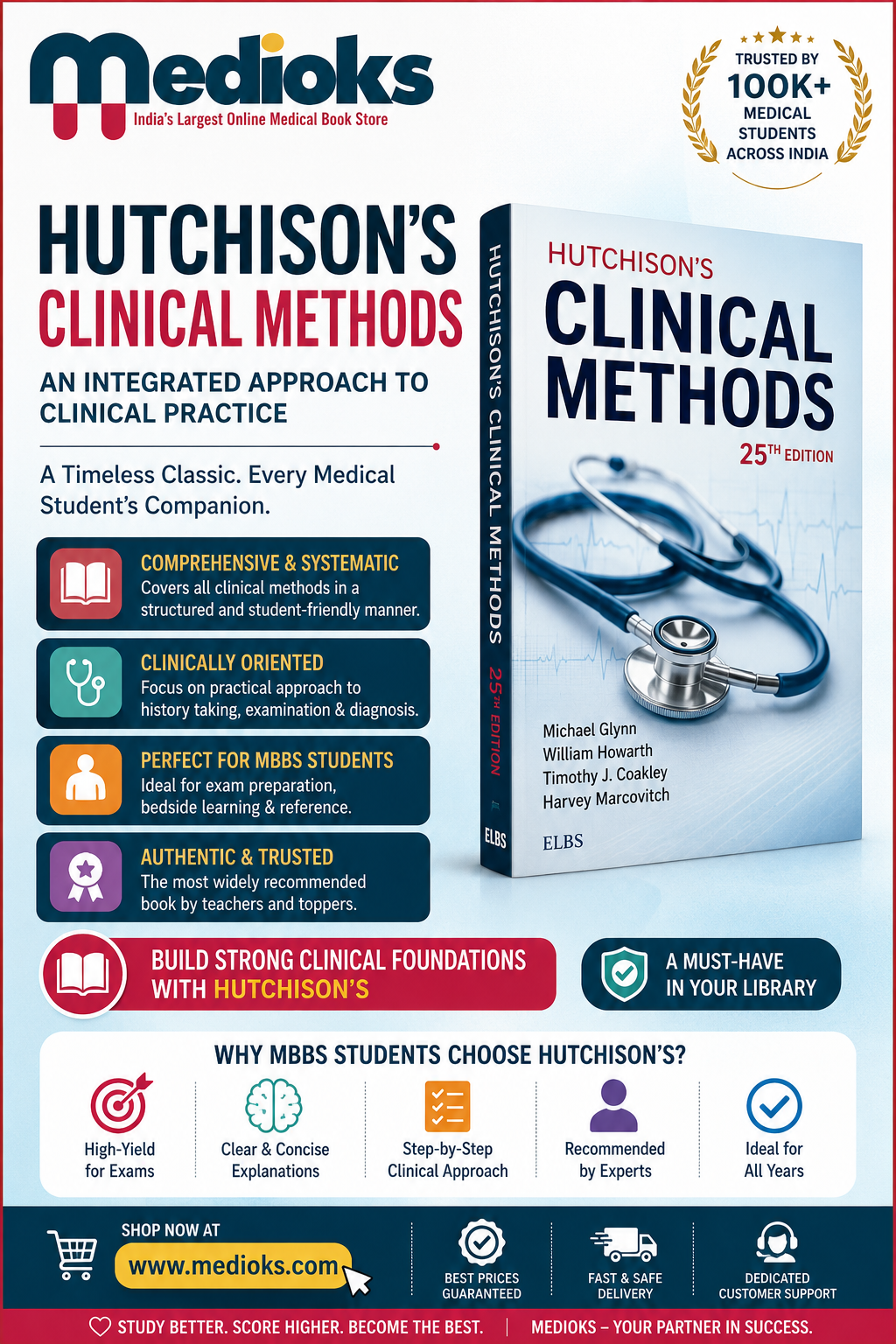
Students searching for Hutchison’s Clinical Methods, clinical examination books, and other MBBS medical textbooks can explore relevant resources through Medioks. Always verify the exact edition recommended by your faculty or institution before purchasing.
Frequently Asked Questions
What skills can MBBS students learn from Hutchison?
Students can strengthen history taking, communication, general examination, systemic examination, recognition of clinical signs, clinical reasoning, differential diagnosis, and case presentation.
Is Hutchison’s Clinical Methods good for MBBS students?
Yes. It is widely used as a clinical methods resource, particularly for developing a systematic approach to patient assessment.
Can I learn clinical examination only by reading Hutchison?
No. A textbook provides structure and explanation, but clinical skills require supervised practice with patients and feedback from qualified teachers or clinicians.
How should I read Hutchison for clinical postings?
Read the relevant system before the posting, observe a demonstration, practise the examination, and then revisit the chapter to understand the findings.
Is Hutchison useful for practical examinations?
It can support practical examination preparation by strengthening systematic history taking and examination. Students should also follow their university’s expected examination format.
Final Thoughts
The most valuable clinical skills every MBBS student learns from Hutchison extend beyond memorizing examination steps.
The book can help students develop a structured approach to:
Listen carefully → Observe systematically → Examine correctly → Interpret findings → Build differentials → Communicate clearly
These abilities form the foundation of clinical medicine.
Yet the real value of a clinical methods textbook appears only when its principles are applied at the bedside. Read before clinical postings, practise under supervision, seek feedback, and connect every physical sign with the patient’s broader clinical picture.
The ultimate goal is not simply to perform a perfect examination sequence. It is to become a clinician who can gather reliable information, recognize meaningful findings, reason systematically, and communicate with patients professionally.